History of Dartmoor in 10 Objects
with Andy Crabb on Thursday, 12 November 2026
at 7.00pm at the Leonardo Hotel, Exeter
In introducing Andy, it was said that he has been working as an archaeologist on Dartmoor for over 20 years for both Dartmoor National Park Authority and Historic England. His role covers all aspects of archaeological management, providing planning advice and even a bit of digging! With over 20,000 archaeological sites on Dartmoor, Andy and his team conserve, monitor and understand this hugely important landscape. Andy has selected 10 objects that illustrate the long and fascinating story of Dartmoor. His talk will cover artefacts, fossils, tools and landscapes, that tell the story of Dartmoor over the last 140,000 years.
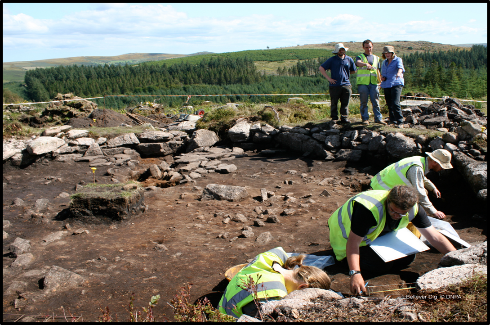 Image from Andy Crabb
In his introduction Andy said it had been a challenge to select just 10 objects but that he had chosen a selection that reflects the significance of Dartmoor’s wonderful archaeological resource and provides a brief introduction to the subject.
1) Straight tusked elephant tooth – Joint Mitnor Cave, Buckfastleigh
The first object is by far the oldest and rarest in this collection which provides a light into a totally lost Palaeolithic world. This object is the fossilised tooth of a Palaeoloxodon antiquus, or a Straight Tusked Elephant, a species now long extinct which roamed around the area approximately 125,000 years ago during a warm interglacial period between ice ages. The elephant would have been large, with individuals reaching 4 metres or 13.1 ft in height and weighing 11 tonnes. A full-size reconstruction can be found in the Museum of Barnstaple North Devon. From preserved stomach contents it is known that they ate maple, hornbeam, hazelnut, alder, ash, beech and ivy. It is thought they could browse to a height of 8m above the ground. The elephant died and the remains were washed, or perhaps brought into the cave where the tooth lay undisturbed until the cave was discovered in 1939 by A. H. Ogilvie. The first excavations took place during the war from 1939-1941 with further test pits being dug by Sutcliffe in 1954-55.
Over 4,000 mammal bones were recovered including the remains of bison, hyena, fox and hippopotamus giving the cave the nickname “The Bone Cave”. The cave is looked after by the Pengelly Trust who provided the image of the tooth, which sadly was stolen in 2015.
2) Mesolithic flint assemblage, Whiddon Down
Following the seesaw climatic fluctuations of the Palaeolithic around 14,000 years ago we emerged into the current warm, interglacial period called the Holocene or “Marine Isotope Stage 1”. The ice retreated northwards as glaciers melted, sea levels rose and Britain eventually became an island. There is good geomorphological evidence that during the last glaciation Dartmoor was covered by its own local ice cap. The tundra vanished as the climate warmed up to be rapidly replaced by forests. The make-up of tree species changed as a result of natural succession. It is believed the forests were much more open, with clearings and that the tor summits may have been tree free. It is also probable that some peat bogs may have been present, and these started to spread slowly ever since. There is some bog oak on Dartmoor – remnants of the ancient forest trapped under the encroaching peat, but careful analysis is still required to date these preserved timbers.
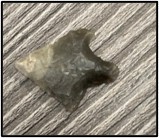
During this period humans permanently settled these shores and lived in small bands that seasonally roamed the landscape exploiting the natural resources, often with the aid of their well-developed flint knapping technology. Evidence on Dartmoor is predominantly restricted to flint artefacts as these survive in the acidic peat roils. Lots of Mesolithic flint artefacts have been recovered from the moor including Whiddon Down, Horrabridge Common and Batworthy. The tools are extremely well made showing high skill levels and immense dexterity, often with multi use meaning that many blades could be mounted onto a shaft and adjusted and refitted in accordance with the job in hand – stripping bark, cutting meat, cleaning hide. Many of the flints appear to be projectiles and were likely used as arrows or spear tips. [A very small arrowhead (pictured) was passed around the audience.]
The size of them indicates that archery was a highly developed skill and that hunting often took place in woodland glades (where space was tight) and the game was much smaller e.g. deer and wild pony. Flint is not natural to Dartmoor, and the best nearby sources are from the cliffs at Beer Head.
 Flint axe head - Bellever Tor. Photo Judith Hosking
3) Neolithic Hand axe, Postbridge
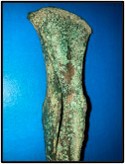
The third object is a beautiful greenstone Neolithic axe that was found near Postbridge. This example, one of about 30 known examples found on Dartmoor now resides in the RAMM in Exeter (and grateful thanks to Tom Cadbury, the museum curator for sharing this image). The axe is around 30 cm long and originally would have been polished to give it a smooth and likely reflective surface and is around 5,000 to 6,000 years old. The greenstone axe is in fact made from a rock called gabbro that occurs in the far west of Cornwall, and these axes were symbolic items. [An example was passed around the audience.] The earliest monuments constructed in the moor are the long barrows and chambered tombs (such as spinster’s rock).
 Object – Andy Crabb, Photo – Judith Hosking.
4) White Horse Hill burial assemblage
The Whitehorse Hill cist was discovered in the 1990s and an excavation was commissioned by the Dartmoor National Park Authority in 2011. It had been discovered eroding from the side of a mound of peat at an elevation of around 600m. A cist is a stone-built ‘box’ inserted into the ground into which the dead were placed in prehistoric times – a precursor to the coffins of today. Initially, attempts were made to preserve the cist in situ, but it eventually became apparent that erosion was too severe and it would eventually be destroyed. The first indication that the excavation had encountered anything unusual was the identification of a bead suggesting that some, at least, of the burial’s grave goods had survived. The grave contained the cremated remains of a young adult, probably a female, which had been placed in the cist in the Early Bronze Age between 1730 BC and 1600 BC. This had been wrapped in an animal pelt, (analysis revealed that it came from a brown bear). It was fastened with a copper alloy pin. Other grave goods included over 200 beads of fired clay, shale, amber and tin which had probably originally formed a necklace, wooden studs which may have been worn as labrets in the ears and/or lips, fragments of textile and leather, a flint tool, a bracelet of woven cow hair and tin studs and a basketry container. Dartmoor is famous for its Bronze Age landscapes. Archaeologists believe that many of the 400 plus burial cairns date from this period.
5) Hoofprints from pastoral livestock, Shaugh Moor
Around 3,600 years ago on what is now called Shaugh Moor, south west Dartmoor herds of domesticated livestock walked or were perhaps shepherded alongside a stone field boundary, and they left impressions of their hooves in the soft silts of the side ditch. A team of archaeologists were excavating bronze age settlements, cairns and boundaries in advance of China clay waste tipping. Closer examination of the hoofprints showed that they belonged to three very familiar Dartmoor animals, sheep, cattle and ponies. A fine cast of the prints was made by Plymouth Museum and can now be seen at the Postbridge Visitor Centre. A badger’s paw prints were also identified. A lidar scan of Throwleigh Common showed the brickwork pattern of linear, reave or field boundaries. The circular features showed hut circles. Dartmoor has 4,000-5,000 of them and they were sustainable and complex structures. Some may have been in continuous use and others used as seasonal dwellings related to summer grazing while others may have just been used for storage, communal meeting places or other activities.
6) Lydford Pennies
Beautiful silver pennies belonging to the medieval period were minted in Lydford between the years AD c.973 and AD c.1050. During this time Lydford was an important town being one of four Burghs (Royally ordained fortified settlements) in Devon. Lydford had the first known jail in England. The pennies are quite small, having a diameter of about 2cm and a weight close to 1.6 grams. Each coin was made of solid silver. Anglo-Saxon silver pennies carried the signature mark of the Moneyer (the Mint-Master) who had minted the coin. Fifteen names of the Moneyers who worked in Lydford are known and included Aelfwine, Aethelstan, Bruna, Goda and Hunwine. The coins also contained an image of the reigning king and also displayed a cross on the reverse side. This was either a short or long cross, the long cross design allowing the coin to be cut into quarters. A silver penny was approximately the payment for one day’s work.
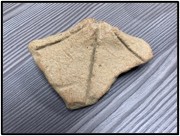 Portion of roof tile shown by Andy. Photo – Judith Hosking
7) Pottery assemblage, North Hall Manor, Widecombe
An excavation of a medieval manor complex in Widecombe in the Moor unearthed a small amount of remains of timber and stone buildings but recovered a tremendous number of pottery sherds with a large proportion dating from the C12th to the C15th which was very unusual for a rural site in Devon. It soon became apparent that the pottery was a significant and diverse assemblage and totally unexpected for such a rural site. Among the finds roof tiles, stained glass fragments and plaster work. There were also fragments of a rare costrel jug found sealed in a boundary ditch, local medieval pottery from Totnes were found in abundance, and amongst the assemblage experts picked out sherds from high status, fine table wares including cups and plates, some of which had come from C14th Valencia, others from C12th Western France or from the Low countries. This showed the Manor had connections and wealth able to import such fancy products from abroad. An image drawn by Richard Parker showed a reconstruction of North Hall and Widecombe and how it may have looked in the Late C14th.
8) Mortar Stone
An image of a mortar stone was shown. They were carefully chosen granite blocks used in the processing of tin ore that provided a strong surface on which tin ore was crushed and commonly found in the ruins of Stamping Mills. These mills are found along the valleys of rivers and streams where tin extraction and processing once took place. The repeated pounding gradually wore the
distinctive hollows in the surface of the mortar stone. Once the depressions became too deep, the block was often rotated and another side became the mortar. Eventually the mortar stones were discarded and it is not uncommon to find multiple mortar stones in and around a former stamping mill. This stamping technology is thought to date to at least the C15th but may be earlier and continued until the C20th. Revenue from tin was so important to the Crown that tinners were often exempt from certain taxes and were allowed to govern themselves with a unique set of laws administered via the “stannary parliament”. Their wealth contributed directly to the development of many of Dartmoor’s fine churches and farmhouses.
9) A stone cutter’s jumper
A jumper was used for drilling holes into granite. Lines of weakness were first identified in the granite and a line scored along it. By repeatedly dropping the jumper onto the same spot, or “jumping” as it was called and rotating the bar each time before it struck again, deep holes could be made into the rock. The holes were spaced about 10-20cm apart. Into these holes two thin iron strips called “feathers” were inserted. A metal plug, locally known as a “tare” was placed between them. The tares were then struck by a hammer in sequence until it split the granite block into a more workable piece.
10) Dartmoor cider press
It is thought cider production took off in England after the Norman Conquest. Up until the First World War cider was a mainstay of the rural economy – particularly in the West Country. Thanks to the skills of the stone cutters mentioned above granite provided the ideal material to be shaped into stones for crushing apples or for pressing “cheeses” against, during the cider making process. An image was shown of an unfinished apple crusher at Merrivale. A crusher was mounted as part of a mill and was turned by horse or human power. The building in which the process took place was often known as the “Pound House”. Another image showed a cider press base. The crushed pulpy residue was collected from the circular basin and then laid on top of a bed of straw covering the press stone. Layers of pulp and straw were skilfully built up to make a “cheese”. A press board was then screwed down bit by bit onto the cheese, and the juice poured out through a spout or grooves cut into the base stone into a trough. Agricultural workers were often paid and provided with cider and most farmsteads had several orchards where the apples were grown. Many of these varieties of apples were often unique to the farm of the local area and had names such as Butterbox, Fair maid of Devon, Slack ma girdle, Sweet bush and Veitch’s, to name but a handful.
This was an extremely interesting and informative talk by Andy Crabb.
(WITH MY GRATEFUL THANKS TO ANDY CRABB FOR PROVIDING HIS NOTES FOR THE TALK WHICH HAS BEEN HEAVILY COPIED FOR THIS SHORTENED VERSION. Sue Jackson)
 Print
