Vikings in the West Country
with Derek Gore on Thursday, 9 July 2026
at Leonardo Hotel
Derek was introduced by our Chairman Neil Ward.
We learnt that Derek retired from the Archaeology Department at the University of Exeter in 2011, where he specialised in the Viking Age. Previously, he had worked in Continuing Education teaching adult classes on the archaeology of the Roman Empire and Early Medieval Europe. In 2014, he published The Vikings in the West Country. He is currently writing a book with three other authors on small finds of the Viking Age from South-West England. He is a member of the Devon and Cornwall Archaeological Societies. In the past, Derek has organised Study Tours for Continuing Education students to a variety of British, European and Scandinavian sites.
Neil said, “Tonight’s talk is entitled ‘Vikings in the West Country’. Previously, it has been suggested that the Vikings largely ignored the South West despite mention of their activities in documentary sources. Derek will now give us a more accurate picture by examining and illustrating all strands of evidence for Viking activities in this area”.
Derek explained that, at this time, there was no kingdom of England, just four areas known as Northumbria, Wessex, Mercia and East Anglia. Between 866 and 874, the Viking Army took Northumbria and East Anglia, killing their Kings. They also took Mercia, whose King fled abroad. The Vikings now held three of the four kingdoms — and Wessex was next on the list!
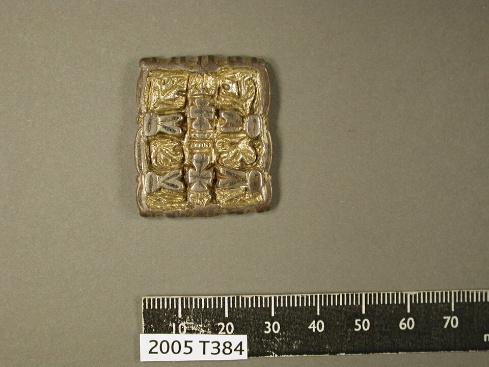 Carolingian strap mount or brooch (Creative commons - Portable Antiquities Scheme, YORYM, FindID: 278508, early medieval, page 1157, batch count 871)
For Devon and the West Country, our story properly begins in the year AD 865. In that year the Viking Army, led by Guthrum, evaded the West Saxon army, crossed Wessex and seized Wareham in Dorset. At the same time a Viking fleet sailed into Poole harbour. The Anglo-Saxon Chronicles stated that the Viking army built earthworks in Wareham in 870, but Derek said that this was not true! There are earthwork ramparts at Wareham and they MAY have already been there when the Vikings arrived — one of the things which may have attracted them to Wareham. It was very rare for the Vikings to construct defences. Normally they made for sites which already had walls or earthworks. They preferred to occupy places that were already well defended (Wareham did have the rivers Piddle to the North and Frome to the South). Derek cited the archaeological evidence for the presence of the Viking army in this area. He showed pictures of a Carolingian mount or brooch, 3 cms square with a Frankish design. This was found in the vicinity of Wareham and will have been dropped by the Vikings. Two lead weights were also found, with a Wessex penny riveted on one of them. These items will also have been dropped by the Vikings.
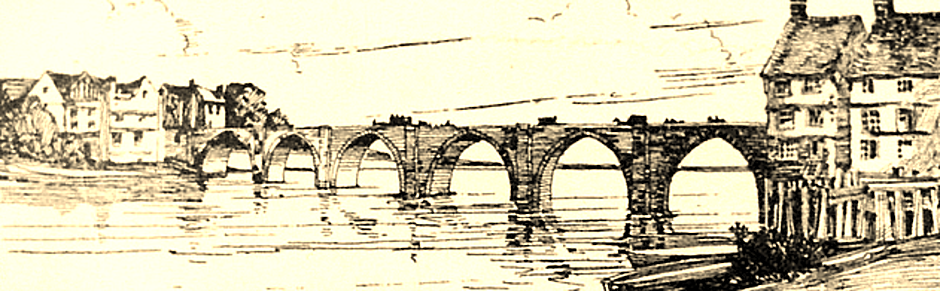
King Alfred brought an army to Wareham, but Derek explained that Alfred bided his time, as the Vikings were securely settled in Wareham, and would have been difficult to dislodge. After a year there, the Viking raiding army moved to Exeter. The Vikings had horses, Alfred only had foot soldiers, so he was at a disadvantage. The Vikings also used their fleet to act in concert with the army, and they sailed from Poole towards Exeter. However, the fleet was defeated by the weather on this occasion, and they lost 120 ships in a great storm off Swanage. However, the Vikings were now secure in Exeter, which was an excellent base due to the Roman roads and walls, and the river. There were two archaeological finds in Exeter, a Carolingian solidus, (which appeared to be gold, but was actually base metal with a gold wash) by the medieval bridge, and a silver penny of Archbishop Ceolnoth of Canterbury (833-870) found in Cathedral Close, in 1932.
In May 878, Alfred had managed to regroup and destroy the Vikings at the Battle of Edington, Wiltshire, with great slaughter (A/S Chronicles). Alfred pursued the Vikings as they fled. As a result, Guthrum and his army retreated into Mercia and East Anglia and settled the lands there.
For the next 14 years, Wessex was able to exist peacefully, as the Vikings turned their attention to Francia (which was weakly governed at the time).
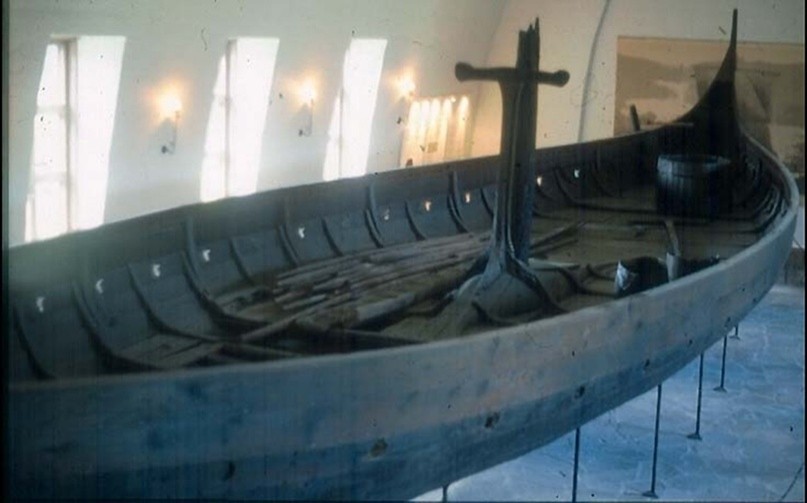 A Viking Longship - Image supplied by Derek Gore
At this point, Derek gave us a lot of information about the Vikings and the Anglo-Saxons, and about the sources we have to rely on. The main source is the Anglo-Saxon Chronicles, which tend to focus on the great rulers and military leaders. We also have Asser’s Life of King Alfred. Derek said all sources need to be used with caution.
Derek showed the Vikings' skill and planning; they were probably Norwegian rather than Danish. Their boats were lightweight with sails and masts, equipped with oars for calm conditions. Because they were shallow, they did not need a harbour. Their target was portable wealth, and their preference was for silver, though they would take gold. The archaeological finds show the distribution of metalwork. At Ilchester in Somerset a copper alloy stud in a lead weight of Viking type was found. A copper alloy disc inlaid with enamel and millefiori glass (Irish 9th century Norse spoils) was found at Colyton, East Devon. A silver finger ring, with typical Viking decoration, was found cut through — to prove it was silver through and through. The Goodrington gold arm ring — made of three gold rods — was found on the beach at Paignton in 1979.
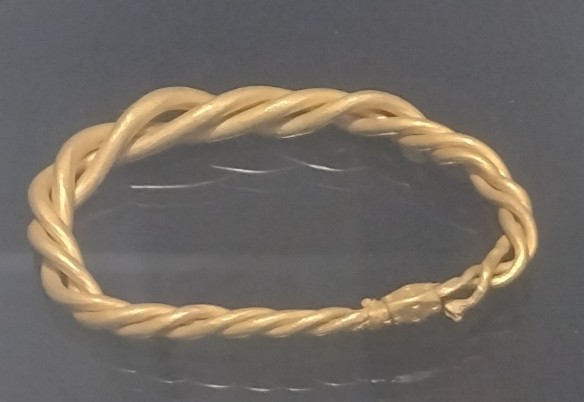 The Goodrington gold arm ring. Image supplied by Derek Gore.
In the second Viking age, under King Cnut, we find more artefacts, such as horse gear (more people were using horses to get around), so horse harness fittings, stirrup strap mounts, and so on turn up, being found by archaeologists and metal detectorists. There is also evidence of increased permanent Viking settlements — with stone sculptures and monuments in churchyards. The hog backs (10th-to-12th century carved Anglo-Scandinavian grave markers) in the North are beginning to appear in Cornwall. The Cardinham cross featuring intricate knotwork and a Manx ring-chain can be found in St. Meubred’s church on the edge of Bodmin Moor. They are evidence that the Scandinavians were settling in Cornwall.
The settlement of Vikings in the area is also reflected in some of the local place names:
- Sleepholme is not a historical Viking name, but rather a modern English adaptation of the Old Norse word “holmr”, meaning an island, a river-meadow, or raised ground in a marsh.
- There is a similar derivation for Flatholme.
- There is also Lundy, which means puffin island, and
- Spaxton — derived from “Spakr”, a Viking or Danish settler who established a farmstead here around the 9th century.
There are also records of Danish landowners prominent in Devon and Somerset, such as Ingvar, Siward, Ttovi and Wicing (meaning Viking). Wicing owned eleven estates around Exeter and in East Devon. Coins were produced and Mint masters, with Scandinavian names, were living in the West Country.
Derek ended his informative talk with an image of the front cover of a book that he has co-written with other authors — South West England in the Viking Age.
Judith Hosking / Sue Jackson (with grateful thanks to Derek Gore for his suggestions and corrections of this article).
 Print
Print 