Spellbound: Witchcraft in Exeter, 1563–1736
with Professor Mark Stoyle on Thursday, 9th April 2026
at 7.00pm at Leonardo Hotel, Exeter
Our Chairman, Neil Ward, introduced Mark Stoyle to a packed room at Leonardo Hotel.
Mark's talk took the form of five sections.
Section 1 — Imagining the Witch
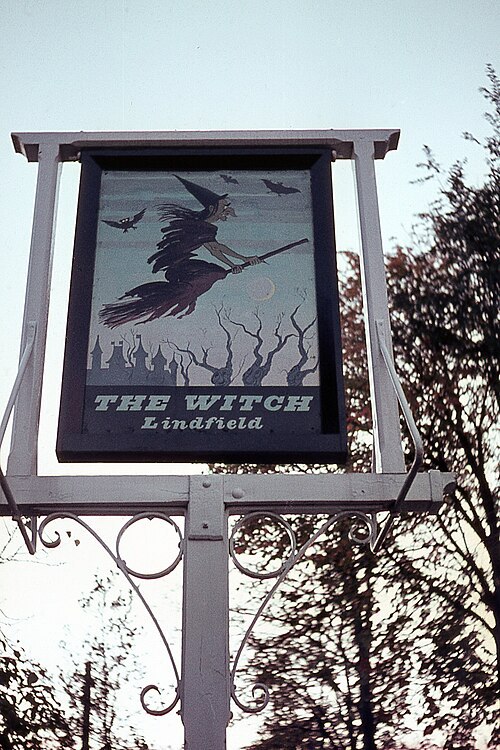 The copyright on this image is owned by Peter Jeffery and is shared under CC BY-SA.
At the beginning of his talk, Mark asked the audience to close their eyes and think what their minds conjured up as to what a witch looked like. He spent some time talking about Hermione in the Harry Potter stories, and Sabrina the Teenage Witch and noted that they were pretty, well dressed and young. He showed a more likely picture of the witch from Snow White and the Seven Dwarfs: the depiction of an old hag with hooked nose and pointed chin, and clothed in a black cloak.
Mark showed images from further in the past — a witch with her familiar spirits (1579) and The Witch of Newbury 1643.
Section 2 — What was witchcraft?
Popular superstition held that a witch or hag was in league with the devil. Further that the said witch had a familiar — who might take the shape of a goat, pig, or calf. Also, that she would fly upon a staff or fork through the air, and would indulge in playing, sporting, and other devilish lusts.
Section 3 — Witchcraft in Exeter, 1563–1660
Mark showed the Hogenberg map of Tudor Exeter (1587), setting the scene for the influence of the Tudors in relation to this topic. Indeed, it was under the Protestant Tudors that superstition and belief in the supernatural seemed particularly to flourish. Mark talked about King Henry VIII, who made Exeter a county in its own right. This meant that the town governors could apprehend, try, and punish those who were accused of a wide variety of crimes. However, witchcraft was not a statutory crime at this time. It was not until 1563 that witchcraft became a capital offence.
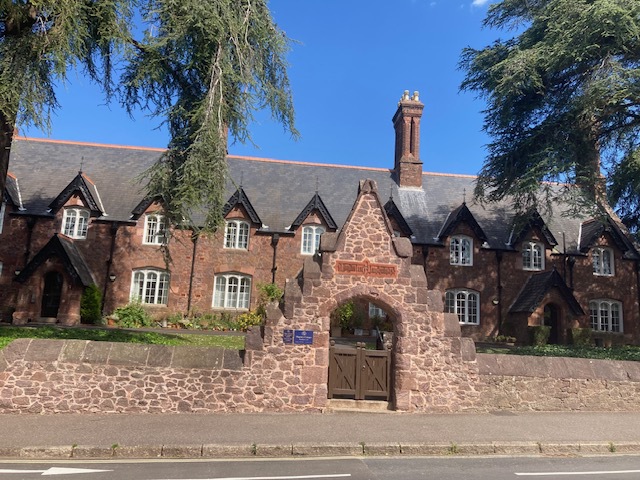 Magdalen Road Almshouses – site of the Exeter City Gallows. Photo by Judith Hosking.
In 1581 Thomasine Shorte of St. Sidwell’s was hanged on the gallows in Magdalen Street (now the site of the almshouses). She was reputed to have killed the wife, son, and daughter of a weaver from Exe Island, through the use of enchantments. She had been a woman of poor reputation, and the magistrates were ready to believe her guilty. She was the first person to be executed for the crime of witchcraft in South West England. She was buried in St. Sidwell’s churchyard.
In 1610 Richard Wilkyns (labourer) from Southernhay was accused of bewitching to death ten pigs in St. Sidwell’s and a horse and a cow in Trinity parish. He had previously been accused of having bewitched a woman to death (1600) and of bewitching another woman in 1606, who subsequently died. On this occasion he was arraigned but escaped with his life. He then was accused of bewitching a man in Trinity parish, and two women in St. Sidwell’s parish. The final straw came in June 1610 when another man died in Mary Arches parish after having allegedly been bewitched by Wilkyns. He was indicted at the sessions in the Guildhall in July 1610, and was found guilty of all charges — except, oddly enough, the one which related to the pigs. His execution at Magdalen Road gallows took place two days later.
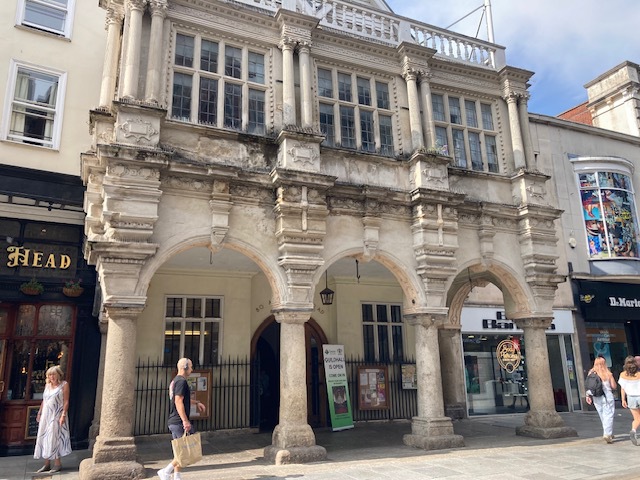 Exeter Guildhall – seat of the Quarter sessions court. Photo by Judith Hosking.
King James I, while still believing in the supernatural, became sceptical regarding some of the cases that were being brought, suspecting that sometimes accusations were levelled for mischievous reasons. However, among the population in Exeter, and in England as a whole, fear of witches remained as deep rooted as ever. Between 1645 and 1647 scores of witches were executed as a result of the activities of the Witch-Finder General Matthew Hopkins. Luckily for Exeter his main area of operations was East Anglia and the South-East, but it reflected the national fear of witchcraft.
Section 4 — Witchcraft in Restoration Exeter: The case of Margaret Clarke
Mark told the story of Margaret Clarke, who had a witchcraft accusation levelled at her in 1664. The accusation was made by Stephen Sparke (son of Christopher Sparke, locksmith). He lodged with Thomas Potter, weaver, as an apprentice. He claimed that his master sent him on an errand, and he forgot his hat, so he snatched a hat from someone called Smalridge who threw a stone at Stephen Sparke. Sparke retaliated by throwing a stone back at Smalridge, but missed him, and the stone unfortunately hit a woman called Margaret Clarke. She shook her fist, hit Stephen with her stick under his ear, and threatened him, saying she would “fit him a pennyworth before the month was ended”. Margaret Clarke was rumoured to be a witch, and Sparke, terrified, interpreted these words to mean that she planned further revenge, of an occult form. That evening Sparke was alarmed to see a black cat following him into the kitchen. The cat seemed to grow larger and larger to the stature of a man. Sparke ran away to his bedroom, leaving the candle burning in the kitchen, and looking back saw the cat slinking away. On the 29th May 1664 Sparke returned to St. David’s parish to go to church and visit his family. However he suffered a nose bleed on the way, and he stopped beside the pound, and saw a great black pig. Sparke took the pig to be a demon, and he followed the pig towards the river. Luckily some people followed him and brought him back, fearing for his life in the fast flowing river. The route that Sparke took follows the same line as does Peep Lane today. On the 21st June, when Sparke was out, crawling through Little Berry Mead (Bury Meadow), he saw another apparition of a black pig wearing a hat, which tried to get him to drown himself. Once again, he was rescued by passers-by. Nine days later his parents took him to the city justices to tell his story. At the same time, Sparke’s former mistress came forward to also make allegations of witchcraft against Margaret Clarke. The JPs then questioned Margaret Clarke, who denied any wrongdoing. She was accused of ‘witchcrafte inchauntments, charmes & sorceries’ — the case was sent for trial, but she was presumably released, and died at home on 19th December 1665. It does look as if the witch hunts were ending, as there was increased scepticism among judges as to witchcraft accusations.
Section 5 — Conclusion: Breaking the Spell?
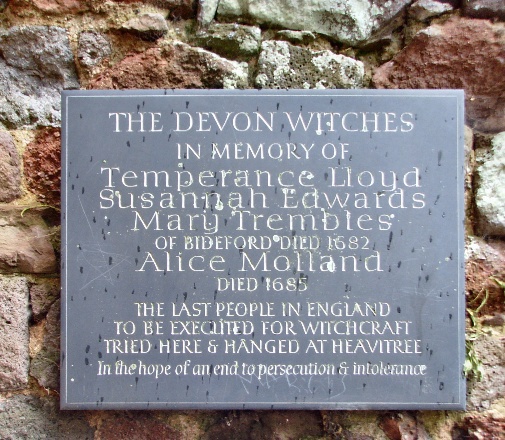 Plaque to the Devon Witches at Rougemont Castle, Exeter. Image – Mark Stoyle.
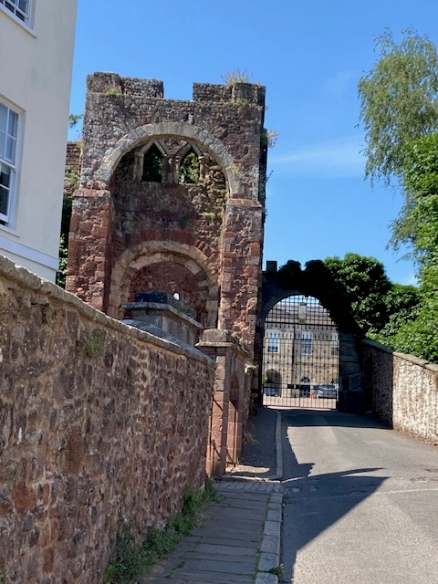 Exeter Castle – site of the trial of the Devon witches in 1682. Photo Judith Hosking.
Although the mass hysteria about witchcraft seemed to be subsiding, there was still a wide belief in witchcraft among the general population. Devon was one of the last places in the country to execute witches, and in 1682 three North Devon witches were found guilty and hanged at Heavitree. Judge Thomas Raymond was under pressure to convict, there being an angry mob demanding a guilty verdict. The trial took place at Exeter Castle. They were convicted and hanged on 25th August. They were buried in unconsecrated ground, located in the vicinity of the car park of St. Luke’s campus. These were the last witch executions in England. In 1736 the Witchcraft Act was repealed. However, the fear of witches persisted for decades to come. As late as 1837 one young Exeter woman, Mary Ann Shapland, openly accused another young Exeter woman, Mary Ann Dymond, of being a shape-shifting witch in the same Guildhall court room in which so many trials of witches had taken place in the past. Shapland admitted in court that she did believe Mary Ann Dymond to be a witch, and accused her of keeping a toad, and infesting her body with lice. The city magistrates treated the claims with amused disbelief, and fined Shapland one shilling for taking advantage of Dymond’s credulity. If this had occurred two hundred years previously, it would probably have led to a very different outcome. It demonstrates how times had changed as far as the authorities were concerned, but also shows how belief in the supernatural had persisted in the general population.
Mark’s talk was very well received, and there were many questions and comments from the audience.
Judith Hosking (with thanks to Mark Stoyle for sharing his PowerPoint, and to Sue Jackson for supplying her notes).
 Print
Print 