“Charlotte Burrow and her letters from Regency Exeter”
with Christopher Lewin on Thursday, 10 September 2026
at 7pm at Leonardo Hotel, Exeter
Neil introduced our speaker, Chris Lewin. “After many years in Southern England, where he worked as a pensions manager, Chris now lives in the Scottish Borders with his wife and a small black poodle. His two sons have grown up to be a lawyer in London and a vet in the USA. He enjoys playing at a local chess club every week. He has had a lifelong interest in social history: how ordinary people lived their lives in past centuries. He believes that the best way to get insights into people’s lives is to study the letters they wrote, their diaries, and their notebooks holding household recipes and accounts. Much of this material has been lost with the passage of time, but some of it can still be found.
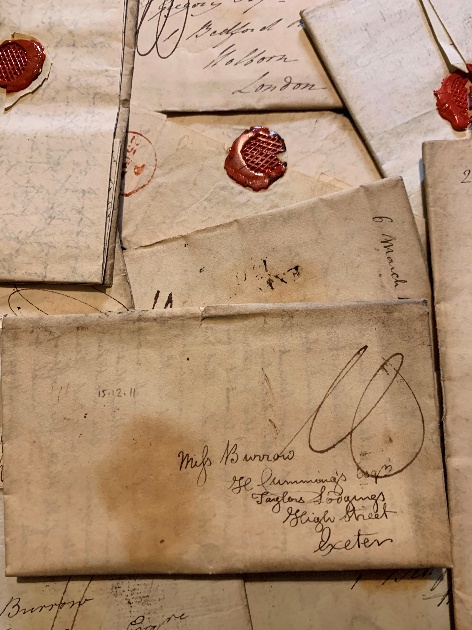 The Charlotte Burrow letters. Image - Chris Lewin
The talk Chris is giving us tonight is titled ‘Charlotte Burrow and her letters from Regency Exeter ’. Ten years ago, he bought, on eBay, an unknown archive of letters written in the Regency period. The dealer was planning to sell them individually if the archive remained unsold, in which case the present story would never have emerged. The letters bring to light a fascinating correspondence from 1808 to 1811 between a young woman in Exeter and her friend in London. Chris will be telling us how their friendship develops over time.
The story has been turned into a book by Chris — “Charlotte Burrow: A Real-Life Regency Romance”, which will be published by Author Gate later this year. The book contains some of the interesting new insights into Exeter’s social history which emerge from the letters, and the talk will include additional information of this nature”.
As a visitor to Exeter, Chris said he had visited Exeter’s Royal Albert Memorial Museum (RAMM) to look especially at Caleb Hedgeland’s model, which depicts how Exeter used to look in the late eighteenth century.
As noted in Neil’s introduction, Chris found this archive of 140 letters on eBay and took a gamble. He bought them rather than risk them being sold individually and the story being lost.
Chris showed a picture of a lady writing a letter at a desk and said that life at this time was different for women. She would have used a quill pen; travel was by stagecoach; lighting was provided by candles. Because paper and postage were very expensive, Charlotte wrote both horizontally and vertically on the same sheet of paper to make the best use of the space. And Charlotte wrote long letters! All of her letters in this collection were written to the same man, a John Gregory, who was a few years younger than her, in whose family she had boarded.
Charlotte’s mother was Lydia Burrow, who had been previously married (in 1774) to John Hobson (son of Samuel Hobson, who was a collector of Excise duties). John Hobson had died in 1781 aged 37, and had left Lydia with 4 daughters — Lydia, Mary, Elizabeth and Lucy. Life must have been hard in those days for a single mother, and in 1782 Lydia married Roger Burrow, who was a maltster, as his father had been before him. She went on to have two more daughters, Rachel in 1784 and Charlotte in 1785. Sadly, Roger died in 1786, now leaving Lydia with six daughters. Roger was buried in St. Sidwell’s churchyard. Lydia survived for another 8 years, dying in 1794 when Charlotte was only 9 years old.
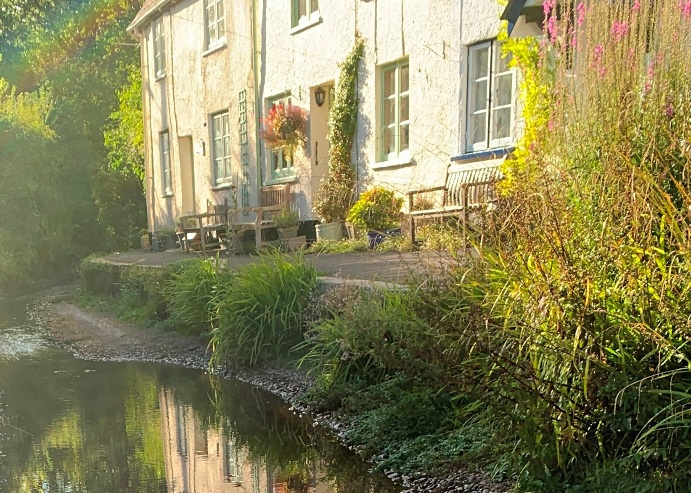 Ide, The College - the brook where Charlotte played among the minnows as a young child Image - Chris Lewin
Charlotte did have some happy childhood memories that she refers to in her letters. The family lived in a country cottage, and she played in the brook at Ide, where the minnows swam round her feet. On his trip to Exeter, Chris Lewin said he had visited College Lane in Ide, saw the brook himself, and could even see some minnows in the water. Lydia seems to have instilled a sense of compassion in her daughters, and Chris showed a poem from 1794 demonstrating this.
Lydia’s older daughters did not inherit much money, but Rachel and Charlotte were a little better off, and were sent away by stagecoach to London to board with the Rev. George Gregory. Chris pointed out that it would have cost £4 14s & 6d to travel inside the coach. But it was a lot more comfortable than the cheaper travel on the top. He showed us images of stagecoaches in all their discomfort. Rev. Gregory had three children of his own (John — 13, George — 11, and Eliza — 7), and took in boarders to earn a little more money. At this time Charlotte was aged 16. George Gregory had written a book against slavery, and also wrote educational books. In 1804 the family and boarders moved to West Ham, where George Gregory was appointed vicar. During their time with the Gregorys, Rachel and Charlotte were able to visit Exeter to sort out their financial affairs, as at the age of 21 they could take control of their own money.
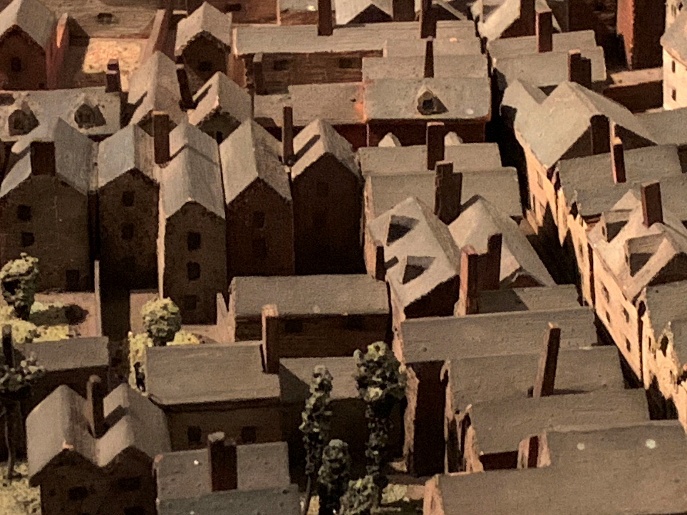 Caleb Hedgeland’s model (made in 1817-1824) in the Ramm, showing Exeter in 1769 as a cramped and crowded city. Photo by Chris Lewin.
In 1808, the Rev. Gregory died, and Rachel married and went on honeymoon to Brighton. Charlotte accompanied the newlyweds. In August 1809 Charlotte returned to Exeter and lodged with her stepsister Lucy whose husband was a dragoon away at the war. This is when Charlotte and John Gregory began their correspondence. Chris said that at the time Charlotte regarded John Gregory as more of a younger brother.
Most of the letters in the collection were those between Charlotte and John Gregory. Chris went on to talk about Charlotte’s letters, which were difficult to decipher, but well worth the effort. At this time, Charlotte was moving around, which included visiting her friend William Nation and his family, who lived in Southernhay. He had a daughter Eliza (born 1786), and a son William (born 1791). These were great friends of Charlotte’s, and are mentioned in her letters. Charlotte was always a welcome guest at their house. A novelist called Mrs Elizabeth Hamilton had said that Charlotte would never be a gentlewoman, which provoked a spirited response from Charlotte. At this time Exeter had very dirty streets, and it was medieval in atmosphere. Charlotte was astonished at the anger caused by a proposal to pave the streets. Charlotte chatted in her letters — about an incident in a lace shop where she went with her step sister Lucy, about her friend Eliza’s engagement to John Adam who she disliked, about John Harris who married a lady 12 years older than himself, but with money. Charlotte said Mrs Harris was short and ugly. Charlotte loved going to the theatre to see Shakespearian plays and also loved dancing and attended the ball to celebrate the Assizes. Never one to pull her punches, Charlotte was disparaging about the drawing of caricatures by William Nation.
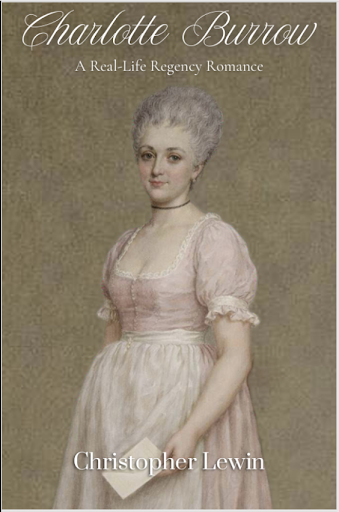 Cover of Chris Lewin’s book - “Charlotte Burrow - a real life Regency Romance.”
Over a period of many months, Charlotte continued to correspond weekly with John Gregory about happenings in her life, and each letter was responded to by him. Staying with John Dennis and his wife in 1810, Charlotte was given to pondering about her future — should she get married and to whom? Among the names probably being considered were John Walter, Robert Gifford, and John Gregory (her correspondent). In 1811 she returned to Exeter and wrote a further batch of letters. Answers to the question of who (if anyone) she might have eventually married were not given to the audience at this talk, but all will be revealed in the book to be published later this year.
John Gregory subsequently became a solicitor, and it may have been him who collected and preserved the letters. Among the letters are some replies from John, and also a few letters to Charlotte from his mother. A question after the talk was about how many letters there were in the archive, and Chris said there were 140, including 12 more from the same dealer on eBay, which he also purchased. Chris said that it is possible that more letters may emerge. Please let him know if you spot any!
Sue Jackson and Judith Hosking (with invaluable help from Chris Lewin)
 Print
Print 