A Walk Around Newtown
with Jackie Holdstock on Thursday, 13 August 2026
On a blisteringly hot day, eleven intrepid members of ELHS met with Jackie at the Waitrose car park, equipped with sun hats, bottles of water, and a determination not to be beaten by the weather.
Turning left out of Waitrose car park, we stopped in some shade as Jackie began by telling us that we were standing in front of Atlas House, which now houses students. Atlas House was purpose-built as a children's hospital, opening in 1913. However, the children were moved the following year when the hospital was requisitioned as a military hospital.
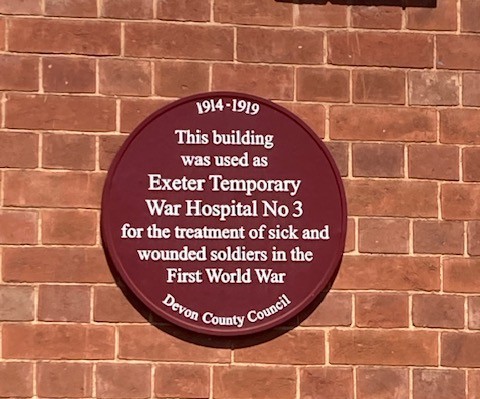
Originally, the children's hospital was built on part of the site of Exeter's 2nd workhouse (the first one was built in the late 17th century on the site of the current Triangle car park). This second workhouse (1745) was built of brick on a healthy elevated site in St. Sidwell's Parish. Behind the workhouse (which accommodated several hundred paupers) a hospital was built. Part of this building remains, and can still be seen.
We moved round the corner on to Grendon Road. On the corner of Grendon Road, where it meets Heavitree Road, was a boarded-up brick-built house called Loma Loma. This was, at one time, home to Charles Edward Rowe. He was a lead manufacturer and Mayor of Exeter in 1902. Subsequently, it was a private residence for Professor Reynolds and used as the Public Analysis Laboratory for the surrounding area. It has just been sold for £650,000.
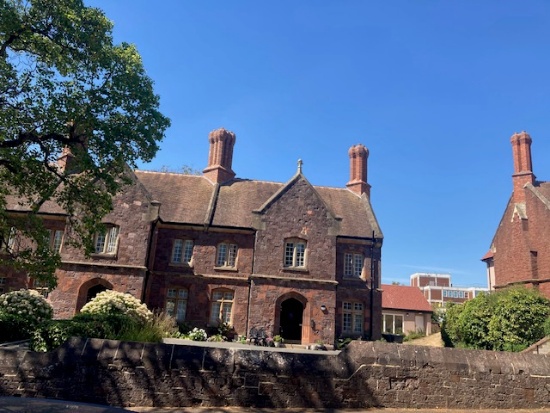 Grendon Road Almshouses.
Grendon Road was named after Simon Grendon who was Mayor of Exeter in 1395, 1398, 1405, and 1406. He was a great benefactor, who provided money for a water supply for Exeter residents. When he died 50 people carried torches in a funeral procession, and he left money to provide them with a suit of clothes.
Moving further on (still hugging the patches of shade) we arrived at Grendon Road almshouses — built in 1883. Jackie pointed out the variety of stones used in their construction. The Almshouses are owned by Exeter Homes Trust and have recently been renovated. Jackie told us that Newtown, though always part of Exeter, used to be quite self-contained with shops and other amenities. The rows of Victorian cottages were built for workers in the local brickworks. As Exeter grew, Newtown was more completely absorbed into the city.
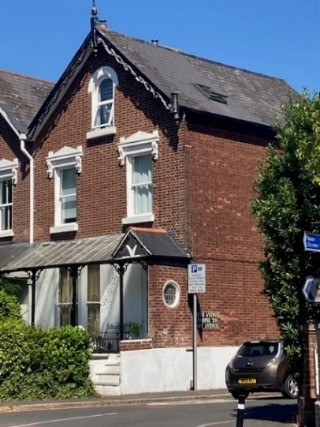 Discombe Villa, 1908, occupied at one time by The Shute family.
Reaching Polsloe Road, we learnt that the name derives from Poll's Marsh (Poll was the landowner and he featured in the Domesday Book). This was an Iron Age ridgeway running from Salmonpool Lane to Stoke Hill. There was also a Roman Road here from St. Loyes Dock — probably through to Crediton. Polsloe Road was flanked by brick and tile works, one of which was Sampson Junior, brick and tile manufacturers. Many of the houses on this road are built of local brick, and in 1900 houses on this road were selling for £375. Polsloe Road suffered badly during the bombing raids in 1942. The former Shute family house is depicted above, and is a brick-built residence opposite the local brickfields.
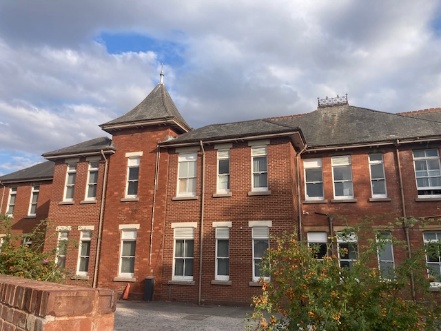 Gladstone House, Gladstone Road – built 1904
From here we turned into Gladstone Road, which is full of hospital buildings of different types. Most of Gladstone House has become offices.
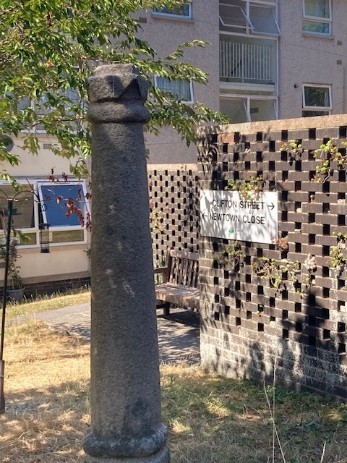
We then proceeded to a small alley between Clifton Street and Newtown Close — and here we saw a granite post (see picture) — possibly from Exe Bridges — which may have been used as a prop for a house in this area. There is a similar post at the Custom House on Exeter Quays. No one seems sure about the provenance of this pillar, but it was a lovely surprise to come across it. Jackie was so pleased that it was still in situ.
We then arrived in Chute Street, the name of which is (sadly) a corruption of Shyte Street. A brook ran down this street in Saxon times, and became the repository of waste — including human! It became known as Shytebrook. The brook was covered during the cholera outbreak, and now only rainwater runs away in it — the sewers taking other waste! This area of Exeter suffered a lot of damage in 1942, and so it was extensively rebuilt.
There were originally 3 pubs in this area, but now only one remains. There had been the Globe, the Golden Lion, and the Clifton Inn (possibly originally the Clifton House Hotel — first mentioned in 1854). At one point the landlord was footballer Tony Kellow, who was the Grecians highest scorer in his day.
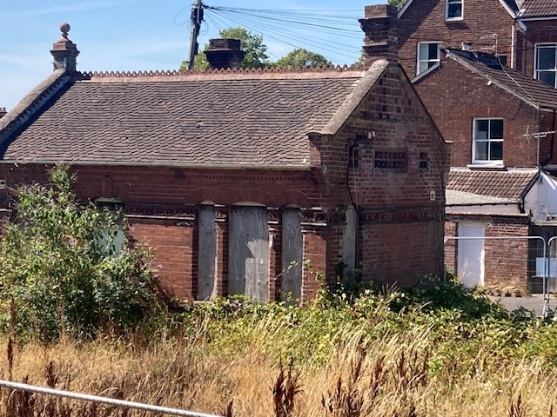
We briefly looked at the rubble, which is all that is left of the aluminium sports centre (built 1984, and demolished in 2000). It was built on the old landfill site, which is unsuitable for house building. There are pipes still visible, which are able to release the methane gas that emanates from the waste site. After seeing the remains of the sports centre, we came across the delightful small building that Jackie had chosen as her mystery building when promoting our walk. This building had been the nearby brick company's sales office, and it is decorated with many different styles of brick. Sadly, it is being left to ruin and is being boarded up. It is surrounded by metal fencing to prevent accidents. From here, we proceeded to the Exeter Ski Club's ski slope and also the golf driving range, which were closed. They are apparently still open for business at certain hours. It all seemed rather run down, and there were tents on the grassy area.
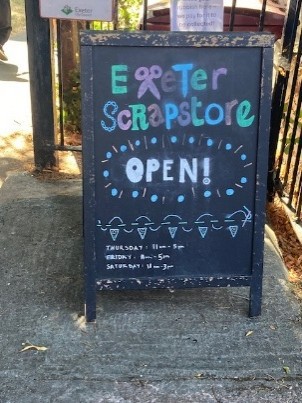
We then arrived at Belmont Park / Pleasure Gardens. This originated from two fields which were given by John Moffat in 1717 for the poor of St. Sidwell's. Later, the land was purchased by the City Council in 1895, and designed specifically for the poor children of Black Boy Road. Before World War II, the Newtown Football Club played here. In 1938 twenty army huts were erected on this site, and the only one now remaining is used by Exeter Scrapstore.
Emerging onto Belmont Road we passed the Parr Street (Daveys) Almshouses. These are 6 Gothic style terraces built in 1833. They are run by Exeter Church Charities. We passed Belmont Chapel also — an evangelical church which Jackie says is thriving.
By this time, we were all feeling hot and tired, so we passed the Vue cinema and the bus station — which Jackie pointed out is too small to accommodate the buses — so that some have to have their stops outside in Cheeke Street, or even in Bampfylde Street.
We arrived, with some relief, at a cool St. Sidwell's Point, for welcome drinks and ice creams in the swimming Pool café.
With thanks to Jackie for a most interesting walk and for telling us some new facts about an area we all thought we knew!
Judith Hosking
(Photos supplied by Judith Hosking)
 Print
Print 