“Hidden Treasures: Exeter’s Library and Literature Heritage”
with Dr Clare Maudling on Thursday, 8 October 2026
at 7.00pm at Leonardo Hotel, Exeter
Neil’s introduction for our speaker covered her wide experience of working for several of Exeter’s libraries, including Exeter Central Library, Westcountry Studies Library (both at Castle Street) and the Devon and Exeter Institution (Cathedral Close). Her PhD was on post-WW2 reconstruction, and her current post is as a postdoctoral fellow at the University of Exeter.
Cathedral Library
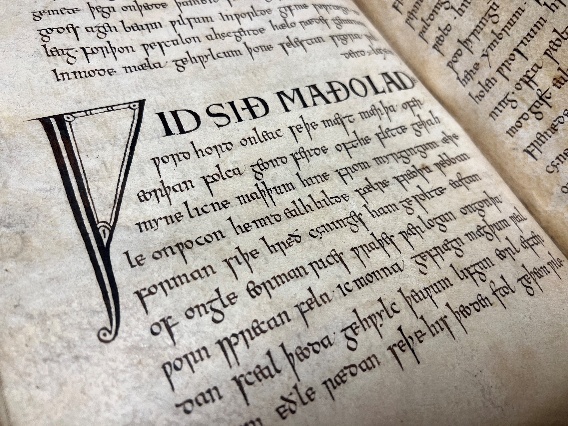 The Exeter Book – Image supplied by Emma Laws, Cathedral librarian.
The earliest collection was in the Cathedral Library, which was founded by Bishop Leofric in 1072 after he had successfully petitioned the Pope to move his see from Crediton to Exeter, and which saw the existing abbey elevated to a cathedral. He donated a collection of 66 books as the foundational collection. Survivors from the original collection can be found in other libraries, including the Bodleian Library at Oxford, and were given as gifts from the cathedral. The most important of these volumes was the Exeter Book, written around 970 by a single scribe, and is a collection of 40 poems and 96 riddles written in Old English (Anglo-Saxon). Only three other Old English literary manuscripts are known to exist — the Beowulf Manuscript at the British Library; the Junius manuscript at Oxford, and the Vercelli Book in Italy. The Exeter Book is the oldest and is, in fact, the oldest book of Old English literature in the world. Over many centuries, donations have added to the library’s collection, with the majority of printed books dating from the 17th century. Many different subjects are covered, most interesting being the collection given on permanent loan by the Royal Devon and Exeter Hospital, creating a unique medical collection covering the history of medicine, anatomy and surgery from the 15th century to the 19th century, from Hippocrates to Galen to Jenner.
Devon and Exeter Institution
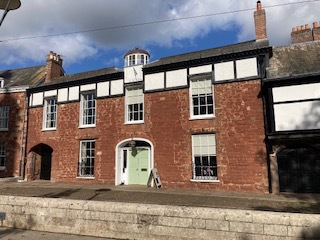 The Devon and Exeter Institution – photo by Judith Hosking
Clare said that reading was an exclusive pastime, with literacy the preserve of the wealthy. The invention of the printing press reduced the cost of producing books, but they remained a luxury item. There was no public library in Exeter until the late 19th century, but private libraries were common amongst the wealthier classes. The circulating library also became common, where books could be borrowed for a fee, and there was known to be at least one in Exeter in the 18th century. The idea for the Devon and Exeter Institution in Cathedral Close was put forward by Edward Leach in 1812, its founding principle being the ‘diffusion of science, literature and the arts’, and was originally planned to house a lecture theatre and museum as well as the library. The money for the new institution was raised through subscription, with subscribers buying £25 shares (approximately £1,000 today) and an annual subscription of £1. This made it the preserve of the wealthy, with landed families of Devon such as the Courtenays and the Aclands among the earliest members. To begin with, women joined as spouses, siblings, and daughters of existing members.
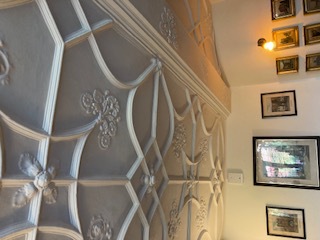 Plaster ceiling in the DEI. Photo by Judith Hosking
The Institution originally rented rooms on the High Street to house the first collections, the landlady being very tolerant of items arriving until being met at the front door by a stuffed brown bear. A move to a permanent home was needed, and this was a building in Cathedral Close which had been the townhouse of the Courtenay family since the 17th century and leased from the Dean and Chapter. The DEI purchased the freehold from the Dean and Chapter in 1814. Still existing as a 17th-century townhouse, there is a fine plaster ceiling in the Courtenay room at the back of the building, plus an overmantel in the same room. Remodelling occurred to create the library, consisting of two handsome, purpose-built rooms known as the ‘inner’ and ‘outer’ libraries with glass domes to flood the space with light from above. Upstairs, a large reading room was created, and balconies around the two libraries could be accessed. Museum cases were added, which were later transferred to the RAMM. Members donated items from their travels. Its book collection consists of natural history, theology, history, travel and an extensive journal collection and one of the few collections of 19th-century local newspapers in the county and a large modern local history collection, along with ‘travel writing’ — accounts of voyages and trips of discovery. This includes a first edition of an account of Captain James Cook’s second circumnavigation from 1778, the accounts of a remarkable lady traveller called Isabella Bird from the late 19th century describing her travels in Japan and the Rocky Mountains, and the life of Joseph Pitts — a sailor who was captured by Barbary pirates in 1678 and sold into slavery in Algiers. The DEI did not house much in the way of literature but had originally held some notable volumes, including another copy of Shakespeare’s second folio, sadly sold off in the 1960s to raise funds to keep the institution open. The DEI was intended to be a scientific institution as much as a library and had planned to have a lecture theatre which was to be built on the back of the building.
Founding of the RAMM and first public library
In 1855, a school of art was founded in Exeter by Sir Stafford Northcote, a member of the local gentry and a politician who had been a secretary to the Great Exhibition in 1851 and one of the keenest promoters of science and art in the city. Exeter lacked a museum and gallery in which the students of the School of Art could display their works or study those of other artists. It was proposed that a museum be created, which became the Royal Albert Memorial Museum. Together with a group of other prominent local figures, including the artist John Gendall, Sir Stafford put together a plan to provide Exeter with a museum along with a proposal that a public library be established as part of the project. There were several libraries in Exeter but none of them were free — the Public Select library, which was a subscription library, the Devon and Exeter Institution, which required membership of the Institution to access, the Exeter Literary Society library, as well as a number of small subscription libraries run by shops. The new City Library would be the first free library in the city.
The museum was funded by local benefactors including Sir Stafford Northcote, and the foundation stone was laid in 1865 and finally opened on 21 April 1870 with the Free Library in three rooms on the first floor. At first the new library had only 1000 lending volumes available, mostly donated by members of the public. This stock was supplemented the following year when the Public Select Library closed and transferred its stock of around 8000 volumes to the City Library. The DEI donated its museum collection to the RAMM, and the items within it made up much of the early collection.
Generous bequests of books and money helped to keep the library going. In 1894 the library received a bequest from Mr A. Pocknell of 520 volumes on the history, development and literature of shorthand while in 1897 a bequest of 4,000 volumes on art, architecture and belles lettres [Wikipedia — “Essays, particularly on literary and artistic criticism, written and read primarily for their aesthetic effect”] was received from Mrs Fisher of Newton Abbot. The largest bequest of books was the 1908 John Brooking Rowe bequest which totalled some 10,000 volumes, including manuscripts and many works about the South West. The most generous monetary donation was the Kent Kingdon bequest of £9,000 to the museum and library to be invested to enable the income to be used to buy new stock for the library and acquire new exhibits for the museum. The legacy of these generous bequests are still felt with the Pocknell, Fisher and Brooking Rowe bequests still being part of the Exeter Central library stock, while the Kent Kingdon Trust still exists.
The emphasis of the library’s stock was very much on ‘improving literature’ and very little light fiction was bought. Some authors whose works would today be considered classics were deemed to be unsuitable for young readers and were kept in the reference section to be read under supervision. The library quickly outgrew its space and within 10 years of opening was already full to capacity and needed more storage space. Newspapers were discarded to save space meaning that there is not a good stock of old newspapers as in some other library services. The Art School moved out into what is now the Phoenix [after it was used by the University College of the South West].
City Library
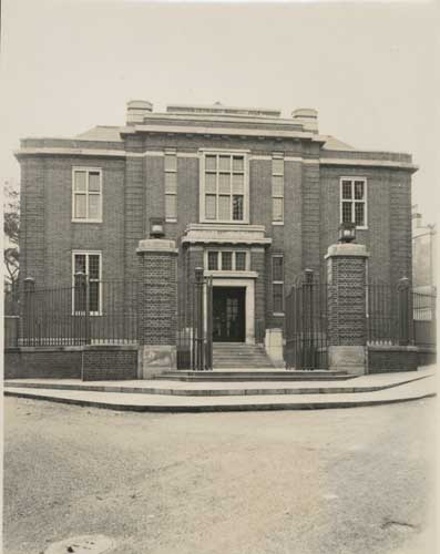 Old City Library – 1930s Image from Clare Maudling
In 1904, Harry Tapley Soper became the first professional librarian in charge of the public library and keen to apply the latest standards in libraries, he made the library one of the best in the region, building up the best reference and local studies collections south of Bristol. Lobbying tirelessly with the city council and the Carnegie Trust for a new library eventually resulted in an award in 1909 of £15,000, one of the largest grants ever made by the Trust. It took a further 21 years, hampered by political rows, the effects of the First World War and a failed redevelopment plan by Thomas Mawson to include a library opposite the Museum, which was not deemed a suitable location. Further delays in securing a suitable site resulted in the Carnegie Trust issuing an ultimatum that if building had not begun by the end of 1925, the grant would lapse. This spurred the council into action and plans for a new library were approved in October 1924, and the foundation stone of the new library was laid on 17 January 1928, completed just over two years later and was formally opened on 11 October 1930 by Lord Elgin of the Carnegie Trust. [This was the building facing onto Castle Street.] The total cost of the building was £45,000, with £26,000 being provided by the city and £19,000 by the Trust [who evidently increased their original grant]. The lending library was on the ground floor, and the reference library was reached by a grand staircase to the first floor. Each floor had galleries to increase storage, and there was a fireproof room for manuscripts. It contained a bookstock of about 65,000 volumes and the building had a capacity of about 80,000 volumes.
War and destruction
The new City library lasted only 12 years before being destroyed in the Exeter Blitz of May 1942 along with much of the city centre. The library was hit by incendiary bombs and gutted, with one side of the building completely destroyed while the other was hugely damaged. Only the muniment room survived, the outer door being completely destroyed, but the massive teak inner door withstood the blaze and protected the collection of manuscripts stored within. Many of the other most precious additions to the collections survived intact as they had been moved out of the city for safety. However, some manuscripts which were being prepared for evacuation were destroyed, along with the entire bookstock amounting to some 93,000 volumes. Harry Tapley-Soper was told by the council to ‘carry on as usual ’, and an emergency lending library was set up in one of the side rooms of the remaining wing of the gutted library building, while donations of books poured in from both the public and sympathetic library services around the country. 5,000 volumes were received in total, making the basis of a new stock along with some 4,000 volumes of the original bookstock which survived by being out on loan at the time of the library’s destruction. A reference service was set up in the adjacent Rougemont House, which was made available by the museum service for the purpose. This accommodation had to serve the city for nearly a further 20 years before a new library rose from the ashes of the old.
Rising from the Ashes — a (second) new city library
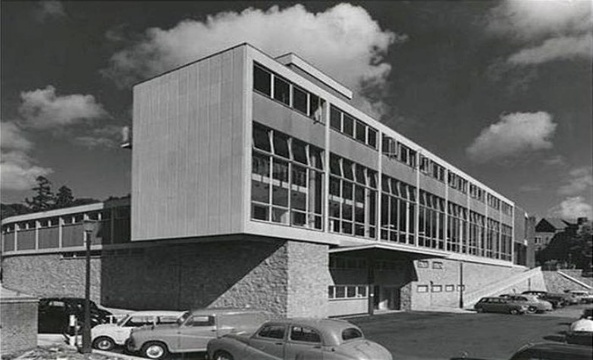 The new city library – Image from Clare Maudling
Harry Tapley-Soper retired in 1946 after 44 years of service and was replaced by Mr N.S.E. Pugsley, who faced the unenviable task of rebuilding the service. He managed to find the funds to buy around 10,000 volumes a year until 1955, when the bookstock stood at a total of 166,000 volumes, which was more than double the working capacity of the building and a remarkable achievement. The temporary building from which he was operating was seriously overstretched, and the Library Committee had to keep reporting this fact to the council before they agreed to the construction of new premises to the south-west of the existing building, which could be completed without interrupting the public service. The existing building was then refurbished to serve as a record office and a book store. The plans for a new library were approved in October 1959, construction began in 1962. It was completed in 1965, and a grand opening ceremony was held on 22 October 1965 with Princess Marina of Kent as guest of honour. Clare described the many new innovations in the new building, with thought given to space and natural light. It had space for a Lending library, Reference library, Children’s library, a mezzanine gallery over the Lending library providing space for the fine art, foreign language and music stock, a Record library, meeting room with space for 100, staff offices and a bindery for basic repairs and stock work.
A reorganisation in 1974 saw the creation of the Westcountry Studies Library, which held two very unusual items. The library had a number of special collections, including the Heber Mardon collection of Napoleonic memorabilia and writings and was the product of his lifelong interest in Napoleon and his hobby of collecting books, prints and other Napoleon-related items, the most unusual being was one of Napoleon’s death masks created after his death in 1821. The second item was even more macabre than the death mask — a book bound in human skin. This practice was fairly common in the 18th and 19th centuries, with convicted criminals able to request that their skin be used for bookbinding after their execution. The book in question is a small, unassuming volume of Milton’s poetry which was bound in the skin of George Cudmore, who was executed for the murder of his wife, Grace, in 1830. Cudmore had not requested that his skin be used in this way and actually thought his body was going for dissection for medical research. The library once had Cudmore’s descendants come to ‘visit’ him in Westcountry Studies after they found out about it.
Libraries today
Many changes took place in the wake of the 2008 financial crash and the resulting squeeze on public finances. Exeter Central Library was refurbished in 2012/13 and reopened in 2014, and Libraries Unlimited, a charity, took over the running of Devon’s libraries.
The Devon Record Office moved out to Great Moor House, the Register Office moved to Larkbeare House, and the Westcountry Studies Library was packed up and accommodated at Great Moor House alongside the Record Office [now renamed the Devon Heritage Centre].
DEI received lottery funding in 2017 to fix the failing roof and conserve the collection. The building was put on the ‘at risk’ register, and the DEI began a fundraising programme to try and raise the funds to repair the roof lights, which had ‘dropped’ about 6 inches in 2012 when there was heavy snowfall. The amount of money needed being beyond their capabilities to raise, an approach was made to the National Lottery Heritage Fund for help, and the DEI was awarded just over a million pounds in funding, with some also coming from English Heritage. The project restored the roof lights to their original copper-clad state, repaired failing timbers, added a steel frame in places to support the roof and also embarked on a conservation project for the bookstock, which had been deteriorating and was in desperate need of care and attention caused by problems with damp, etc. A further grant in 2020 of £1.85m enabled more of the interior to be refurbished, including two ground floor rooms which had been used as an office and the ladies’ loos and returning the upstairs reading room to its original state as one long room, taking out the 1898 partition and opening up a roof lantern which had been closed in. It created a small new extension on the back of the building to house new, accessible toilets, a lift to the first floor, and office space. It also rewired the building, tackled some further damp problems, and put in new underfloor heating.
This was a full and very comprehensive talk by our speaker and was greatly enjoyed by our members, and thanks were conveyed to Clare.
[I am greatly indebted to Clare Maudling for the text of her talk, which has been heavily incorporated into this write-up. Sue Jackson]
 Print
