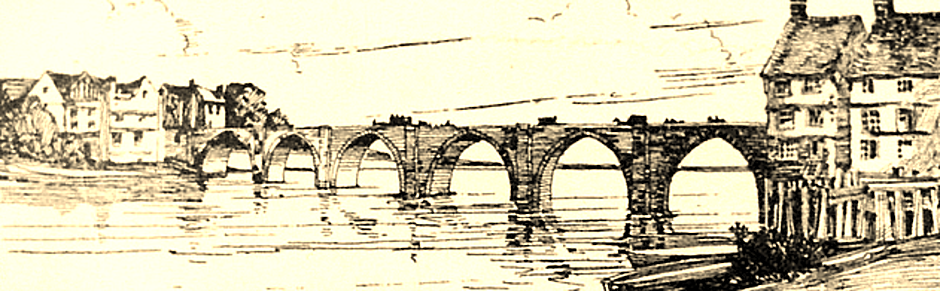
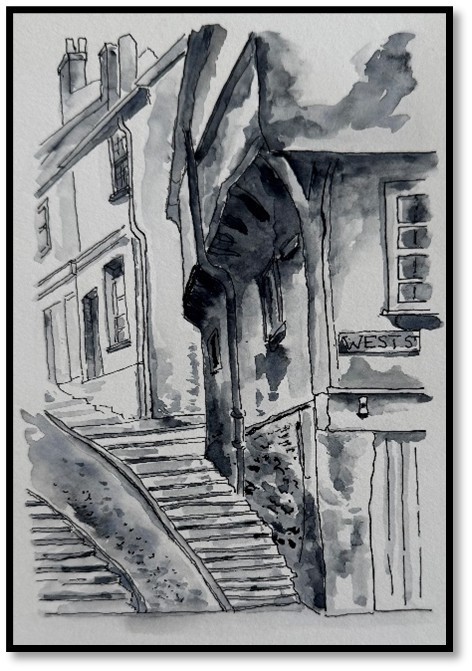
 Stepcote Hill - ©Maddy Jevon with permission
Exeter in the 1920s — Sunshine and Shadows
with Dr Julia Neville on Thursday, 9 October 2025
at 7pm at The Mint Methodist Church Centre
Following Neil Ward's introduction, he handed over to Julia Neville to talk about the Exeter in the 1920s project and the format for the programme.
First was a film by Emberlense Productions called "Guildhall Rhythm", featuring the South West Lindy Hoppers dancing the Charleston in Exeter’s Historic Guildhall, with the added comment by Julia that the Charleston was considered slightly risqué in the 1920s.
This film was followed by “Best of Times, Worst of Times” — a dramatic programme presented by a group of volunteer actors, featuring real-life characters who lived in the West Quarter in the 1920s. To quote the programme note: “At the end of the First World War, all local authorities were asked to identify districts where the housing was dilapidated, insanitary and/or overcrowded and thus ‘unfit for human habitation’, and to make plans to rehouse the inhabitants and clear the buildings. The area between Fore Street, West Street, Coombe Street, and South Street, known as the West Quarter, had once been a prosperous part of the city, but its spacious houses had been turned into tenements and left to decay when the well-to-do moved away. Exeter City Council designated it as one of these ‘slum areas’. But the country was hit by a recession, and the plans for new affordable housing failed to materialise. For almost 10 years after that, the residents of the West Quarter lived in a limbo, uncertain what their future would be and unable to improve their situation. Now, a group of researchers based at the Devon and Exeter Institution has explored the family histories of the people who lived there, and from that research developed the stories of the characters that you will hear this evening. Please note that some imagination has been used to round out the characters where the full facts are not known.”
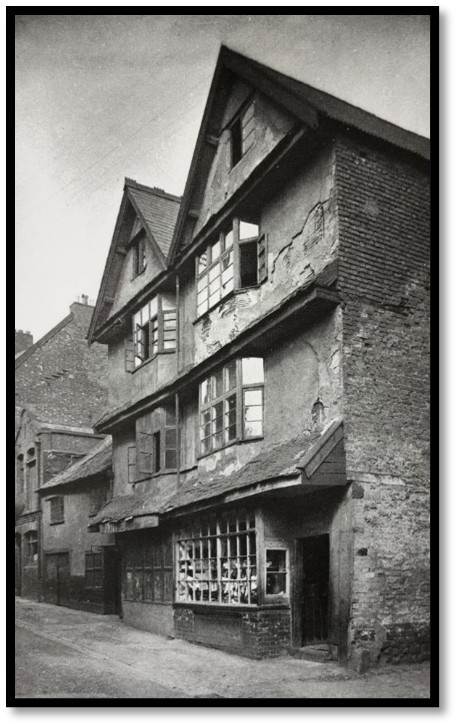 Preston Street - ©Maddy Jevon – with permission
A cast of actors brought to life the characters of Lilian Shapcott, a girl from Preston Street, Alex (or Alessandro) Casalucci, an ice-cream salesman, Annie Cann, wife and mother, Thomas Griffin, a haulier, Maud Spicer, widowed when her husband died after war-related injuries, James Slack, a drover and occasional poacher, Catherine Bailey, a property owner, Charles Tucker, a boy from Parsonage Place, and John James (“J.J.”) Berry, baker and sportsman. Their stories brought to life what it was like to live in streets such as West Street, Stepcote Hill, Rack Street, and Preston Street, among others. A common theme among the different stories was the poverty and the need to take advantage of the Farthing Breakfasts, the communal wash house, using the bakers’ ovens to cook the Sunday roast dinner, the large number of children born to the families, and the babies and young children who died in infancy.
Alessandro Casalucci spoke about his family who had come to Exeter from Italy and ended up as ice cream makers [I well remember their café in Cowick Street in the 1950s], and another frequent theme among the speakers was getting into trouble with the law because of salmon poaching, not having a licence for a vehicle, and some ending up in prison. Many of the women were laundresses, and one purporting to be from a “respectable” family had a sideline in money lending. Life could be very difficult for some women who suffered violence at the hands of a drunken husband, and there were tales of some men and women having suffered the loss of a spouse, being left to bring up a number of children on their own.
Halfway through these stories, we were treated to a rendition of Bye Bye Blackbird by the SongFishers.
A lecture or illustrated talk on life in the West Quarter in the 1920s would not have served so well to bring to life what it was actually like to live through those “Best of Times, Worst of Times”. What came through very strongly was that by acting out the lives of some of the characters, we saw the way families learned to cope with their lot, whether good or bad. This led to a community of spirit which existed between West Quarter families, and highlighted what was lost when residents were moved out to the new housing estates of Burnthouse Lane, Buddle Lane, and Whipton.
An illustration from this author's family, whose father was born in Horse Lane (off Quay Lane) and having lived in Quay Lane itself, was being moved out to Myrtle Road for a time to a brand new house on the Buddle Lane estate. However, his mother so missed the area she had been born in, that she decided to move back to Quay Lane again – and this indeed was the address my father was married from in 1945. He was born in 1914, and I well remember his tales of attending Rack Street Naval College (aka Central School) and of his mother losing three of her nine children in infancy, and also her first husband in 1924.
This was a well-attended event and very much enjoyed by everyone. Our thanks are due to Julia Neville for masterminding such an interesting, and indeed sometimes moving, evening and to the talented actors and singers who brought it to life.
Sue Jackson
 Print
Print 