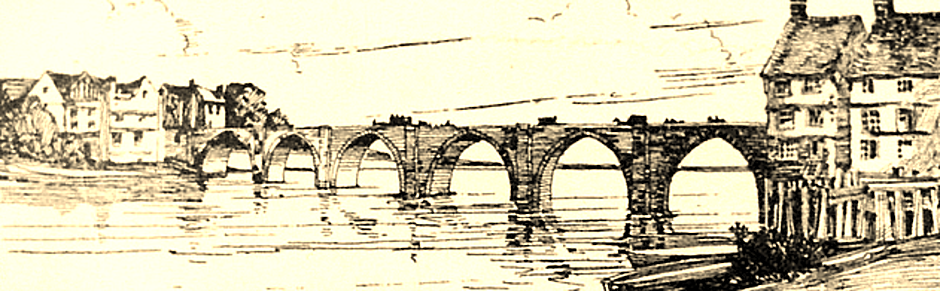
“Through the Windows of an Ordinary House – a History of England”
with Dr Ian Mortimer on Thursday, 28 May 2026
at the Leonardo Hotel
Our speaker is best known as the Sunday Times bestselling author of the four Time Traveller's Guides as to what to expect to encounter on visiting Medieval England, Elizabethan England, Restoration Britain and Regency Britain. He is a prolific author of medieval biographies, of a prize-winning novel, several other titles and is also a writer of poetry. He is a Fellow of the Royal Historical Society and a Fellow of the Society of Antiquaries and has been described by The Times as ‘the most remarkable medieval historian of our time’. He lives on the edge of Dartmoor in Moretonhampstead with his wife Sophie who accompanied him to the talk. Their home has a history that can be traced through medieval, Tudor and Edwardian times and was the subject of Ian’s talk and forthcoming book of the above title.
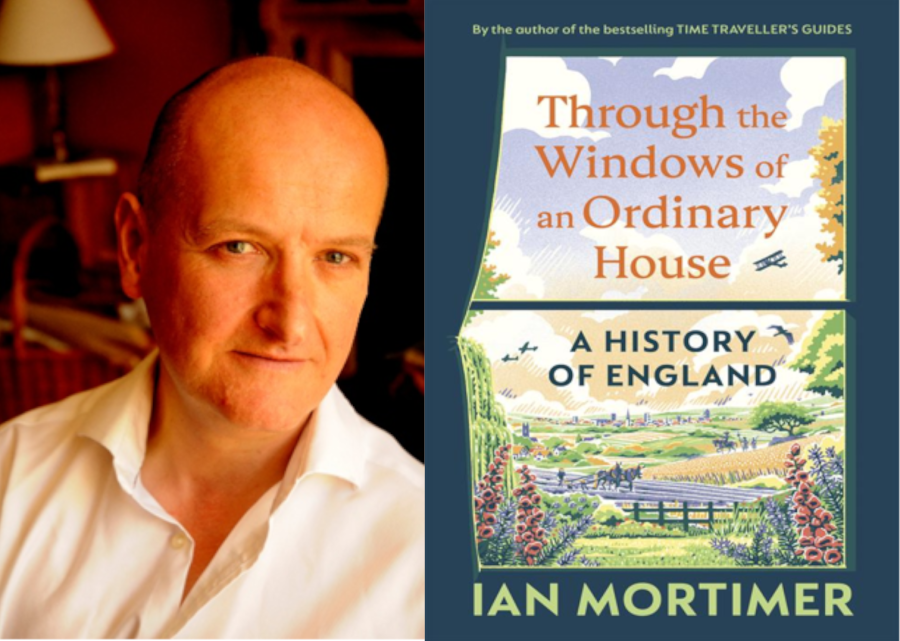 Ian Mortimer's new book – with thanks to Ian Mortimer.
The book shows how the national story differs hugely according to where you were living, and looks at how the history of England would have appeared to the people who lived in his very own house (and previous houses on the site) since Saxon times.
Ian talked about ‘Mearsdon’ in Cross Street, Moretonhampstead under the following headings:
- Origins of Moreton
- Origins of Mearsdon
- Four Windows across 1300 years:
- Window 1. 1170 – 1227 – Alicia de la Moor
- Window 2. 1567 – 1618 – William Stonying
- Window 3. 1826 – 1849 – William Dodd and his son
- Window 4. 1908 – 1943 – Charlie Laycock
He talked about Moreton’s appearance in the Domesday Book and here I will quote from the very interesting website www.moretonhampstead.org.uk: “The first appearance of Moreton in the written historical record is in Domesday Book, compiled in 1086. Roughly translated, the entry for Moreton reads as follows: Moreton a royal manor. At the time of King Edward the Confessor’s death it paid tax for three hides (units of roughly 80–120 acres). There is land for twenty ploughs. In lordship there are three ploughs and six serfs (unfree labourers) cultivating one hide; and sixteen villeins (villagers) and six bordars (smallholders) with eight ploughs cultivating two hides. There are twenty acres of meadow, sixty acres of pasture; the woodland is one league long and one furlong wide. There are twenty cattle and one hundred and thirty sheep. It pays £12 in tax weighed and assayed, the same as it did when Baldwin acquired it. To the manor of Moreton belongs the third penny of the hundred of Teignbridge.” [Access the “History of Moreton” section of the above-mentioned website for full and very interesting details.]
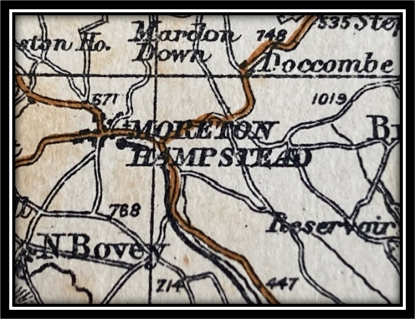 Setting the scene - Moretonhampstead on Bacon’s County Map – 1910. Image from a map owned by Michael Hosking.
Ian showed several maps of Moreton and surrounding parishes overlaid with straight lines for gardens equating to Bronze Age reaves – a 4-pole measure grid system. Again I will quote from the website in the first paragraph of the “History of Moreton”.
“Today the most common association with the name ‘Moretonhampstead’, or ‘Moreton’ as it is usually called, is the moor – Dartmoor – which rises to a height of two thousand feet within sight of the town. Such a close association has deep roots. Our medieval forebears might have looked up to the western horizon and seen only an inhospitable line of hills from which they could extract tin, and seen nothing of beauty, but the moor has always dominated the place which the town now occupied. Four thousand years ago the Bronze Age settlers who built the long field systems (‘reaves’) across the moor extended their hedge-topped stone walls to divide up parts of the parish of Moreton too. At Butterdon their works may still be seen, with the odd standing stone in their midst, as a subtle relic of their vanished culture. Their field system shows that they farmed at Cranbrook, where their Iron Age successors built a substantial hill fort, one of a series circling the moor. Later still Dartmoor proved an inhospitable and unwelcoming frontier for Roman culture, which disregarded the Moreton region as part of the moor. Only when the Saxons arrived did the place become a settlement distinct from the moor which overshadows it. And what did the Saxons call it? Moor-tun: the settlement in the moor.”
Ian went on to describe the origins of his house, ‘Mearsdon’, and showed plans of the layout of the house together with various original deeds. The earliest was a Quitclaim of Adam of Moreton, Clerk to Henry Suter 1300 and another of 1443 of the owner John Peryam 1541–1618 who was an MP and Mayor of Exeter. Ian’s research showed that there had been many different occupiers with people from various trades including shoemakers, shepherds, and woolcombers.
Ian then returned to the ‘Four Windows’ he mentioned at the start of his talk.
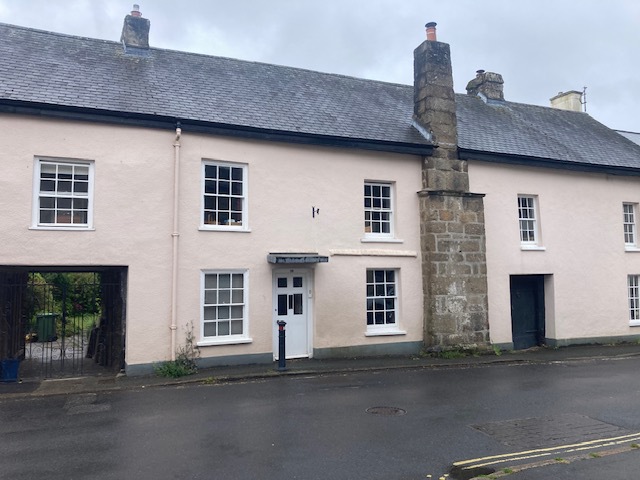 “Mearsdon” – photo by Judith Hosking.
1. 1170 – 1227 – Alicia de la Moor
The manor of Doccombe, which was donated to Canterbury Cathedral, was exactly one quarter of Moreton. The Cathedral kept very detailed records, which help study the history of the area.
This explained how the murder of Thomas Becket 200 miles away led to our being able to understand how land was distributed. Doccombe (part of Moreton until 1174) is a separate manor and is best for documents. A section of the website about Doccombe reads: “The lordship of the manor of Moreton remained in royal possession until Henry I gave it to his illegitimate son, William de Tracey. It then passed from William to his daughter Grace, and from her to her son, another William, who adopted the name ‘de Tracey’. This man was the knight who assisted in the murder of Thomas Becket in Canterbury Cathedral in 1170. After the deed he went into exile and in 1173 divided off the manor of Doccombe from that of Moreton, giving ‘100 shillings of land in Doccombe’ to the monks of Canterbury Cathedral. Doccombe remained in the hands of Canterbury Cathedral throughout the Middle Ages. It was leased to the Gregory family in the nineteenth century.”
2. 1567–1618 – William Stonying
Known as William Stonying of Honychurch he was the only occupant of Mearsdon to be known by the title of ‘Gentleman’. He served as an auditor at the Exchequer in London and although he was not known as a ‘gent’ in London, through his auditing role he managed to acquire various plots of land in Devon (along the route of taking livestock to market) and as such was seen as an important man locally, and relatively well off by the standards of Moreton, hence acquiring the soubriquet of “gent”.
Ian cited the wide wooden mouldings on the doors in Mearsdon, which were dated at around that time and were quite expensive. He must have had a horse (otherwise, he wouldn’t have been able to commute to London). He died in 1618 and was buried in St. Andrew’s Church, Moreton.
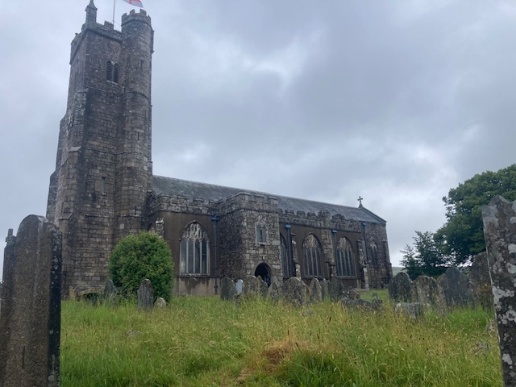 St. Andrew’s Church, Moreton - photo by Judith Hosking.
3. 1826 – 1849 – William Dodd and his son
William Dodd became engaged when he was about 18, but had to go to war before he could get married. Upon his return, 15 years later, he found out that his fiancée had waited for him and married her. Just before the wedding, he raped a young servant girl who was walking from her parents’ home to her master’s. She told her master and her uncle about the episode, and the uncle went to the police. William Dodd was arrested right after his wedding and found guilty. Ian said that newspapers of the time liked to cover dramatic court cases and read out extracts from a Dorset newspaper of the reported crime (sanitised for the reader of the day) and that being known in Dorset it probably was seen by Thomas Hardy who used very similar themes for his ‘Tess of the Durbevilles’ plot.
His son committed theft which led to him being transported to Australia where he met the woman who became his lover. Following their murder of the lover’s husband the son and lover were caught after the forger they used to change the will of the murdered man informed the police of what had happened. He was OK with being a forger but didn’t want to be associated with the crime of murder.
4. 1908–1943 – Charlie Laycock
In 1908 Charlie Laycock bought Mearsdon. He was a collector of old objects and wanted to use the house as a museum. Ian was able to show photographs of the interior rooms of the house along with the old objects and furniture he found to display.
Ian showed a wealth of photographs of the interior and exterior of the house and some which had displayed former signs during its time as Mearsdon Tea Rooms and as a Stove Centre.
The previous owners to Ian and Sophie lived in the house between 2004–2013 at which point Ian and Sophie bought it from them and have lived there ever since.
What transpired from this hugely interesting talk about the history of the house and its place in Moretonhampstead, is that it was anything but an ‘ordinary house’ as we might understand it. Mearsdon is one of only four very early houses that remain, given the number of fires that Moretonhampstead has suffered down through the ages including neighbouring houses in Cross Street. During the many years of research carried out by Ian he discovered which houses were the first to acquire electricity and also tracked down the fact that a local pub had the telephone number 5 begging the question of who were those who had numbers 1 to 4?
Sue Jackson
30.5.2026
With grateful thanks to my fellow committee members who were able to add the details I failed to record in my note-taking.
[The Moretonhampstead website is thoroughly recommended and bears the following sections: Doccombe Manor, Documentary archives, Farming, Gazetteer, Glimpses of the Past, History of Moreton, Lords of the Manor of Moreton, MHS databases (very useful for family history research), Newspaper Cuttings, Online Archives, Programmes, Who was who?]
 Print
Print 