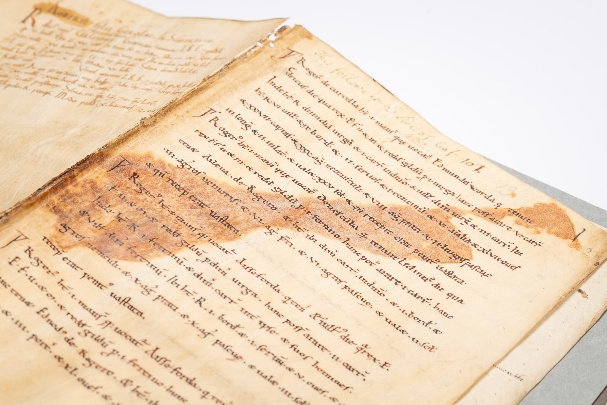
 Exon Domesday - Photographer - Simon Tutty with permission of the Dean and Chapter of Exeter Cathedral.
“Exeter Cathedral: A Thousand Years of Treasures”
with Emma Laws on Thursday, 11 June 2026
at the Leonardo Hotel
Neil Ward introduced our speaker who was appointed Exeter Cathedral Librarian in 2022. Emma Laws has Master’s degrees in Information and Library Studies from the University of Wales, Aberystwyth, and in The History of the Book from the University of London. She began her career at the Royal Library, Windsor Castle, and was a curator at the Victoria and Albert Museum for over 20 years, specialising in the history of the art and design of the book and book illustration. Emma came to the Cathedral from the Devon and Exeter Institution where she was Director of Collections and Research.
It was a welcome return as Emma had previously given a talk to Exeter Local History Society in September 2024 on the “Exeter Book”, a famous collection of medieval poetry, which has been at Exeter Cathedral since Leofric, the first Bishop of Exeter. Her talk, this time, also included the opening this year of the brand new Friends’ Cloister Gallery and Treasures Exhibition.
Emma explained that the Cathedral Library and Archives are split between the Archives which includes materials relating to the Dean and Chapter, together with other material, such as Exon Domesday, and the Library of 25–30,000 books, established for the use of Clergy, including all areas of knowledge. Emma mentioned Thomas Glass, who, in his will of 1786, bequeathed his substantial library of medical books to the Dean and Chapter of Exeter with the requirement that they must: “permit any physician being an inhabitant of the city of Exeter to have recourse to them at proper times in the library...”. His act of generosity introduced a new public readership to the Exeter Cathedral Library and established a legacy that continues today. Effectively, the library was the first public library in the city!
The history of the Cathedral goes back nearly 1,000 years, starting with Bishop Leofric who came from Cornwall and had been in France in the household of Edward the Confessor. When Bishop Lyfing died in 1046, the king made Leofric Bishop of Cornwall as well as Bishop of Crediton. Emma showed an image of the Foundation Charter of 1050, which was laid on the altar of the Abbey Church in Exeter for the ceremony. It was signed by Edward the Confessor, Archbishops of Canterbury and York, Bishops of Winchester, Salisbury and Worcester and various Abbots and Lords (it records the great and the good!). It had been necessary to ask Pope Leo to move the seat from Crediton to Exeter as, being a walled city, it was felt to be more secure than Crediton, because of a fear of Viking sea-raids. The Saxon minster, already existing within the town (and dedicated to Saint Mary and Saint Peter) was used by Leofric as his seat.
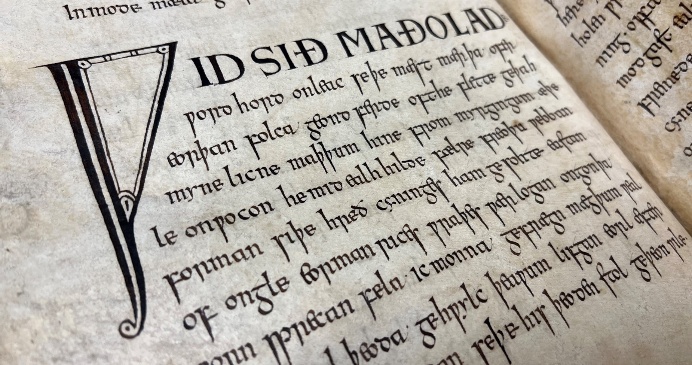 The Exeter Book – Image provided by Emma Laws.
After the Norman Conquest Leofric was one of only seven Anglo-Saxon Bishops allowed to remain in post – all the others were replaced by Norman Bishops.
Leofric donated a foundation library of 66 books in the form of manuscripts. One of these titles is the Exeter Book, which is now kept in an environmentally controlled secure exhibition space (and is on permanent display) and is the only book of the original 66 to remain at Exeter. The other 65 have been given away or dispersed. The Exeter Book has no illustrations but is beautifully written. It consists of lyrical poems and riddles in Old English. It has not always been treated as a treasure. In 1327 the inventory does not include the Exeter Book, it was seen as worthless at that time. However, it has now been recognised as a Treasure, being one of the best preserved and oldest remaining books of Anglo-Saxon poetry. The others are the Vercelli Book in Vercelli Chapter Library (Italy), the Nowell Codex (containing the poem Beowulf) in the British Library, and the Junius manuscript in the Bodleian Library.
In 1107 William Warelwast was appointed to the see, and this was the catalyst for the building of a new cathedral in the Norman style. Its official foundation was in 1133, during Warelwast’s time, but it took many more years to complete. Following the appointment of Walter Bronescombe as bishop in 1258, the building was already recognised as outmoded, and it was rebuilt in the Decorated Gothic style, following the example of Salisbury. However, much of the Norman building was kept, including the two massive square towers and part of the walls. It was constructed entirely of local stone, including Purbeck Marble. The new cathedral was complete by about 1400, apart from the addition of the chapter house and chantry chapels.
Exeter Cathedral has the most complete set of building accounts of any English Cathedral. They are called the fabric rolls, and are written in medieval Latin, which is hard for us to decipher. They consist of over a hundred manuscripts (1279–1520) and record minute details of Cathedral finances. For example, there is documented a payment for 4 horses bought in Crediton (Easter 1323)!
Exeter Cathedral Misericords (Mercy seats) predate the fabric accounts for use by clergy. They include a kind of shelf to rest against as an aid to standing for long periods. Of the fifty misericords in the Cathedral, 48 date from 1255–75 and 2 others from the fourteenth century. Amongst other things, they depict the earliest known wooden representation of an elephant in the UK. They are one of the oldest sets of misericords in the country.
The library developed further in the Middle Ages. In 1327 John Grandisson became Bishop; he commissioned and annotated more manuscripts including the 1337 Ordinale Exon, which dictated Cathedral worship and liturgical music. He left a legacy of books to the Cathedral. Books were stored in the upper floor of the Chapter House. The medieval Cloister is now no more, but would have had 11 desks, located between the buttresses. In 1412 there were 194 volumes, bound and chained.
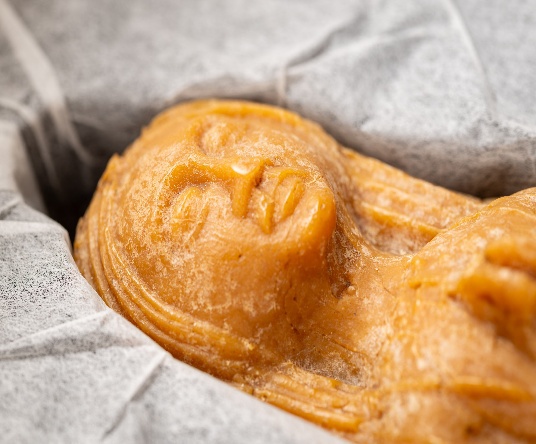 Wax votive - Photographer - Simon Tutty with permission of the Dean and Chapter of Exeter Cathedral.
Bishop Edmund Lacy (1420–1455) was venerated as a healer, though he was never canonised. There is evidence that pilgrims would have visited his tomb, seeking healing. After the bombing of the Cathedral in 1942, a wax votive figure was found in a hoard above Lacy’s tomb. These wax votives were common, but fragile; it is amazing that one survived complete. It is the figure of a woman made from beeswax. The Reformation put an end to such wax figures. This one can still be seen in the Treasures Exhibition. Exeter Cathedral also had many relics (including the reputed arm of St. Piran) which would have been destroyed during the Reformation.
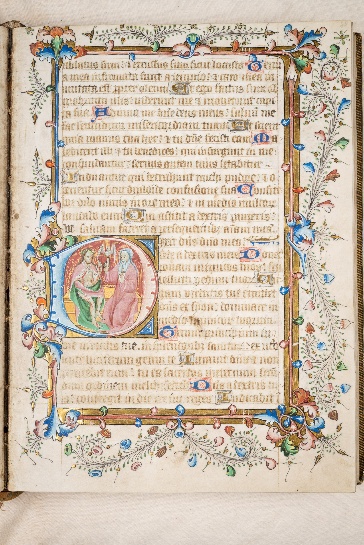 Fortescue Book of Hours. Photographer - Simon Tutty with permission of the Dean and Chapter of Exeter Cathedral.
In the Cathedral (near the Lady Chapel) you can still see two book boxes, which would have contained devotional books like ‘Books of Hours’ which detailed the prayers to be said during the day and night. The Fortescue Book of Hours (Fortescue protected William the Conqueror at the Battle of Hastings) can be seen in the Treasures Gallery. After the Reformation Books of Hours were banned in England. It was no longer permitted to pray to the Virgin Mary but instead you were told to pray directly to God.
In this period of destruction of Cathedral liturgical objects, it was common to repurpose a vestment as a tablecloth / altar cloth. Emma described the various parts of the ornate cloth known as St. Petroc’s Pall. This can still be seen in the Cathedral collection.
In 1566 the Dean and Chapter presented to Matthew Parker, Archbishop of Canterbury, a manuscript of the Anglo-Saxon Gospels which had been given to the Cathedral by Leofric in 1072. Eighty-one manuscripts from the library were presented to Sir Thomas Bodley for the Bodleian Library at Oxford. In 1657 under the Commonwealth the cathedral was deprived of several of its ancillary buildings, including the chained library of 1412–13. Some books were lost but a large part of them were saved due to the efforts of Dr Robert Vilvaine, who had them transferred to St John’s Hospital. At a later date he provided funds to convert the Lady Chapel into a library, and the books were brought back.
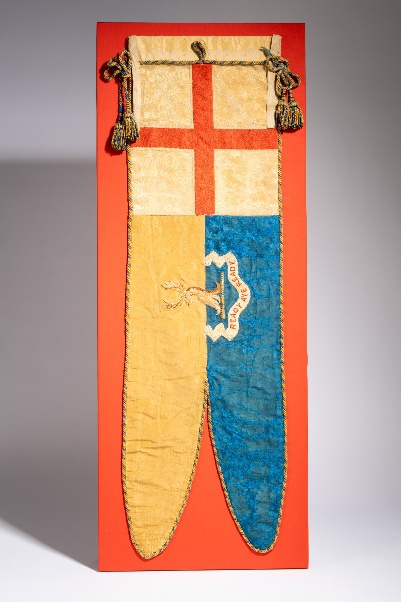 Scott’s Sledge flag - Photographer - Simon Tutty with permission of the Dean and Chapter of Exeter
Dean Charles Lyttelton began restoring Exeter Cathedral by putting its archives in order, a task he completed in 1751. Sam Smiles documented that Lyttelton’s work on Exeter’s muniments proved foundational; those archival records yielded Lyttelton an intimate knowledge of the cathedral’s medieval construction, and Lyttelton wrote up his findings in what Smiles deems to be a remarkably “empirical” essay in 1754. “Lyttelton’s use of records,” Smiles explains, “would prove to be decisive, allowing him to provide evidence in place of the conjecture and local tradition on which his predecessors had relied”. Lyttelton lent the Exon Domesday Book to Salisbury Cathedral. Exeter luckily had it returned, and part of it can be seen in the Cathedral Treasures Exhibition. The Domesday Book itself is, of course, housed at the archives in Kew. However, our regional West Country contribution to the Book was preserved and is held in the Archives.
The last notable treasure mentioned in Emma’s talk is the original sledging flag of Robert Falcon Scott (1868–1912), used by him on his first Antarctic Expedition. It is made of silk. It has been in the cathedral since Scott’s family gave it to the cathedral in the 1920s. It has now been restored and can be seen in the Treasures Gallery.
This was a most interesting talk, and we all learnt a great deal about the history of the Cathedral Treasures. Emma encouraged us all to visit and see these remarkable objects for ourselves.
Sue Jackson and Judith Hosking (with much needed assistance from Emma Laws).
 Print
Print 