Exeter Guildhall and Mace Sergeants
Talk by Jerry Glazier on Thursday, 8 January 2026
at 7pm at Leonardo Hotel Exeter [Jurys Inn Exeter Hotel]
The talk was attended by a very small number due to the adverse weather forecast for Storm Goretti which had also resulted in public transport being cancelled.
Jerry Glazier is one of Exeter's Mace Sergeants who are ceremonial figures who have three main parts to their role:
- Taking the Lord Mayor to over 300 events during their year in office as essentially bodyguards for the Lord Mayor and responsible for protecting them and their Regalia.
- Taking part in civic events as mace bearers.
- Security for private events and guides at the historic Guildhall.
He started his talk by asking if those present had visited the historic medieval Guildhall, the oldest building in continuous use in Exeter. It was the place where all the Guilds used to meet in times past. The last remaining Guild in Exeter is the Weavers, Tuckers and Shearmen, which meet at their own premises at Tucker’s Hall in Fore Street. All apprentices to a trade had to be members of a Guild in order to become Freemen of the City. This then allowed them to practice their craft. An apprenticeship was usually for seven years.
Exeter was granted the right to have a mayor around 1200, and the current Guildhall dates from 1330. However, there was a building on the site as early as 1160 and this was located in Fore Street before that section of the road became High Street from its junction with North Street at the Carfax. Exeter was one of the largest cities in England, and High Street was part of the Fosse Way.
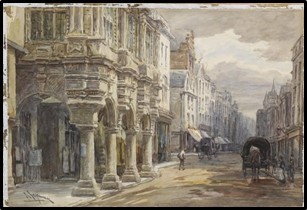 Guildhall and view of the High Street – 1890s Image courtesy of the Guildhall.
Jerry showed a series of images of the Guildhall in High Street. The names of all the mayors down through the ages are known. Only one of them was executed! Jerry recounted the story of the Cathedral precentor, Walter Lechlade who was murdered as a result of a conspiracy between the Dean (John Pycot) and the mayor (Alured de Porta). Five of the conspirators plus the mayor, were executed in 1235, but the Dean (as a churchman) was merely banished to Wales. Another image which was shown was dated to before 1888 as there were no tram lines in the High Street. The trams ceased to run in 1931, as the tracks were wearing out and there was a difficulty in maintaining electric power.
Exeter was the third most important city in England when it was granted the right to have a mayor, and in 2002 the role was upgraded to Lord Mayor by Queen Elizabeth II – hence the wearing of black robes. Exeter’s wealth was in wool.
Jerry went on to talk about cholera in Exeter, where most deaths occurred in the West Quarter, the poorest area. He showed a portrait of John Perriam in 1616 aged 76 who served twice as Mayor. He described the layout of the building including the Hogsheads at the back of the Guildhall where water was stored above the cells holding women prisoners. The cells were subsequently rebuilt.
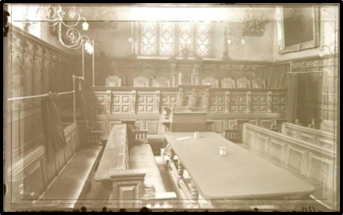 The glass plate negative digitally enhanced of the Exeter Guildhall courtroom. Thanks to the Guildhall for this image.
We were shown a glass plate negative, digitally enhanced, of the Guildhall courtroom before 1887, and a vintage photograph of the City Regalia with the Sword given to Exeter in 1447 by Henry Tudor, the Cap of Maintenance, and the waits’ chains given to the city’s official singers which go back to the 1400s and the Maces dating from 1730 which are silver gilt. The first Mace Sergeants were appointed in 1263 and four were appointed at that time. The Exeter Bread Riot in January 1854 was of national notoriety, and featured in the Illustrated London News.
One photograph was a view of the Balcony, and the Guildhall has portraits of people from Exeter or who visited Exeter. Jerry mentioned owning a book by the Revd. George Oliver entitled History of Exeter which describes all the coats of arms around the Guildhall where there are eighty panels with archways, every one of them unique. The oak panels were installed in about 1594, when the guilds contributed to the cost. In 1887 a bust of Queen Victoria was added to celebrate her Golden Jubilee and the coats of arms for four people were taken out and are no longer there.
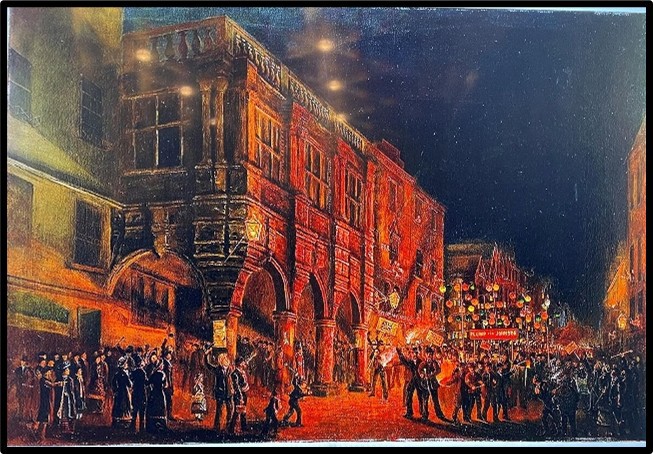 1880 – Election Night scene of the Guildhall. Thanks to the Guildhall for the permission to use this image.
Exeter had a Sheriff up to 1974. There was a painting dated 1880 of an election night scene outside the Guildhall.
All financial deals were done in the Guildhall, which was also used as the Magistrates’ Court. It was also the place where Judge Jeffries found thirteen people guilty of treason and they were then executed. It was also Exeter’s first police station. There was a picture of the Turks Head pub next door to the Guildhall, a building which is a hundred years younger than the Guildhall. In addition, there was a picture of a civic procession under Broadgate to the Cathedral.
Jerry said he very much enjoys his job as Mace Sergeant, and he likes talking to visitors about the Guildhall. From visitors, he has learnt of family links to a former Mayor, and met the person who made the bust of Queen Victoria.
Supplementary information copied from an interesting booklet, "EXETER GUILDHALL,"" First published 1991, revised edition 2007 by John Allan of Exeter City Museums
“Mayor The first mention of a mayor in England is that of London in about 1191; a Mayor of Exeter is first recorded in 1205. A new mayor has been elected annually since that time in unbroken succession. In 2002, the city of Exeter was granted the status of Lord Mayor on the occasion of the Queen’s Golden Jubilee.
Recorder and Town Clerk
The ancient office of Recorder of Exeter is first documented in 1352, when the salary was £3 per year. The post has its origins in the city’s law officer, first recorded in 1246. The origins of the post of Town Clerk go back to the 12th century: a deed of about 1160 mentions a Records Clerk. The post was superseded in 1974.
Aldermen and councillors
Aldermen were introduced in 1281. They were appointed annually for each of the wards of the city to preserve peace and suppress nuisances. The present Council comprises 14 aldermen and 40 elected councillors.”
Sue Jackson
 Print
Print 