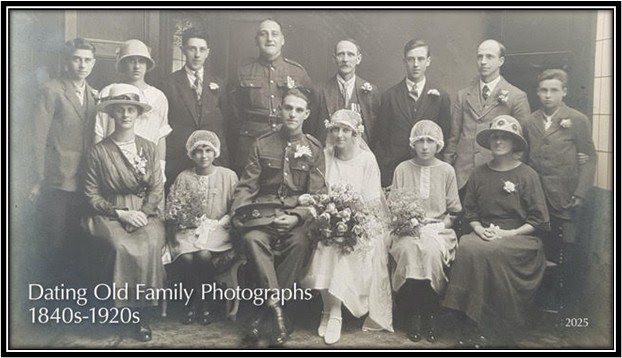
“Dating Old Photographs 1840-1920”
Talk by Sally Macdougall on Wednesday, 10 December 2025
at 7pm at Leonardo Hotel Exeter [Jurys Inn Exeter Hotel]
Our speaker has been known to the author of this write-up for a very long time, through our membership of Devon Family History Society and the events we have attended together in order to man the sales table of DFHS publications. Sally is also the editor for the DFHS magazine, a post she has held for many years. She loves to share her discoveries about family and local history, as well as her passion for images – old photographs or Christmas cards.
Sally very helpfully provided a crib sheet to go with her lavishly produced Keynote presentation and brought along many books that she had found useful and some examples of the various types of photographs and a typical early album. Her crib sheet listed six headings when attempting to date family photographs:
- Ask your family members
- Look closer
- How did you come to have the photograph?
- Determine the type of photograph
- Check for a photographer's name or mark
- Share your photographs on social media with your family.
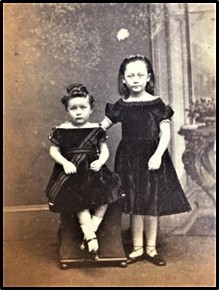 Carte de visite - showing two children.
Sally urged members to get to know their own photographs and look for clues, for example, why was the photo taken? Was it a family event such as an engagement, wedding, or anniversary, a memorial, a statement of personal achievement, a sporting event, a publicity photo, or a photo of someone famous?
She suggested using a magnifying glass to pick up anomalies in the pose, and whether it might be a possible engagement or wedding photograph. Check for a ring, and have a best guess at the date, the process and format used, and also look at the reverse of the image to see if there is more information which may be useful.
Sally outlined the various types of photographs — daguerreotype, carte de visite, cabinet print, ferrotype (tintype in USA) 1850s-1930s, postcard, or roll-film print. Daguerrotype (1839-mid 1850s) were cased images and framed, were often hand coloured and covered with glass and sitting in a wood/leather case or frame. Collodian Positive (1850s-1880s) (ambrotype in USA) with under-exposed negatives on a glass plate were cheaper for working people to afford, ferrotype and known as tintype (1850s-1930s) were more affordable and used by beach and fairground photographers. Union case made of thermoplastic, a mixture of shellac, wood shavings and dye. Albumen print (1850s-1890s), Cartes-de-visite (1855-1915 4”x2.5”), Cabinet cards (1865-1915) and other formats and sizes.
Sally recommended measuring the size of any prints or negatives, which could help to narrow down the year they were produced. References to these are found online. Snapshots on roll film from 1888. Kodak brought out different formats, and from 1900, the Box Brownie camera was popular. Early colour photographs (from c.1907) showed real colour. Sally showed an example of a double-ended album.
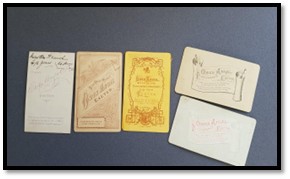 Backs of carte de visite – much information can be found here.
Sally showed that the reverse of a photo will give a wealth of information — for example, trade plates, which were adverts for photographic businesses. For example, Owen Angel had a photographic studio in Exeter from 1848 to 1890. Many photographers lived over their studios with family members assisting in the business. Postcard portraits (c.1894-1940s) were popular, and up until 190,2 all of the reverse of a postcard was supposed to be used for the address. After 1902, the backs were printed with a line down the middle to allow a message as well. Check for a stamp or postmark giving clues about a date.
Sally recommended studying the image for studio style, whether a painted backdrop or classical background, landscape or building or other props. For composition with groups of people, the best and sharpest focus was in the centre of the image; people on the edges were not always in focus and photographers often placed the best looking people in the centre! Study the costumes for women (look at sleeves and hats), and for children, and for men, whether they had hats or different types of facial hair. The experience of having a photo taken involved keeping still and often a chair with a head restraint was used and for children, mothers were hidden within the frame, behind curtains or disguised as a chair. Check whether earlier photos were copied or retouched and whether sitters were in old-fashioned clothes, fancy dress and theatricals or fakes. Were they copies or originals? Deduce whether children were boys or girls and remember that boys often wore dresses and skirts before being “breeched” between the ages of 4-7.
Finally, Sally talked about preserving and recording and using safe storage for photos, either in acid-free wallets or paper envelopes. It was recommended to either write in soft pencil on the back of the photo or record details on the paper envelope, number it and also record in a book.
Sally's handouts included a list of useful reference books and websites, and her talk could probably inspire many of us to have a go at dating the photographs we all have in our possession. It was a very interesting, informative and light-hearted talk for our final meeting of 2025.
Before taking questions, Sally handed over to her husband John, who has set up his own photographic studio at their home in Exminster, an enterprise in honour of his 9-year old granddaughter Poppy, who has spent periods in the Children’s Hospice Southwest in between four open-heart surgeries for her complex heart conditions. In lieu of payment for a studio portrait, his philanthropic photography is a fundraiser for this wonderful facility for children suffering life-limiting conditions. To find out more, go to www.philanthropicphotographic.co.uk or to support the charities that have been so supportive of Poppy, please go to www.justgiving.com/page/john-macdougall-1691075468474
Sue Jackson
 Print
Print 